Mortgage rate forecast for next week (May 4 – May 8, 2026)
Mortgage rates fell for the three consecutive week of decline.
The average 30-year fixed rate mortgage (FRM) declined to 6.23% on April 23, 2026 from 6.30% the prior week, according to Freddie Mac.
The 30-year fixed-rate mortgage declined again this week to 6.23%. Rates currently stand at their lowest level in the last three spring homebuying seasons. This improvement, coupled with a pickup in purchase applications and refinance activity, as well as an increase in monthly pending home sales, underscores signs of improving momentum in the market.
| Average 30-year fixed rate | 1-week ago | 4-weeks ago | 3-months ago | 1-year ago |
| 6.23% | 6.30% | 6.38% | 6.09% | 6.83% |
The latest borrowing activity
Though lagging, the most recent weekly mortgage application report from the Mortgage Bankers Association showed a seasonally adjusted 0.8% decrease for the seven days ending March 27. The refinance index fell 3% week-over-week while standing 4% lower from a year ago. The purchase index rose 1% weekly but came down 7% year-over-year.
“Higher mortgage rates and continued economic uncertainty weighed down on mortgage applications again,” said Joel Kan, deputy chief economist at the MBA. “However, certain loan types and geographic segments are faring better than others because of lower rates on ARM and FHA loans as well as growing housing inventory in some local markets.”
Find your lowest mortgage rate. Start hereIn this article (Skip to...)
- Will rates go down in April?
- 90-day forecast
- Expert rate predictions
- Mortgage rate trends
- Rates by loan type
- Mortgage strategies for April
- Mortgage rates FAQ
Will mortgage rates go down in May 2026?
"Anyone claiming certainty about rate direction right now is overconfident. There's genuine uncertainty in the air, and the data is pulling in multiple directions."
-Tony Julianelle, CEO at Atlas Real Estate
The 30-year fixed mortgage rate sat at 6.3% as of April 30, with the 15-year fixed at 5.64%. That puts rates in a narrow band that has defined much of the spring, and there is no obvious catalyst to break them out of it in the near term.
The Fed meets May 6-7 and is widely expected to hold its policy rate steady, which removes one potential source of volatility early in the month. That leaves the bigger question for May: whether incoming inflation and employment data shift the timeline for a summer rate cut or push it further out.
For now, borrowers are looking at a month where rates are more likely to drift than swing. But the data has been pulling in competing directions, and a single strong or weak report could change the calculus quickly.
Expert mortgage rate predictions for April

Hannah Jones, Senior Economic Analyst at Realtor.com
Prediction: Rates will hold steady
Mortgage rates have made meaningful progress in April, falling to 6.23% this week, the lowest level in three consecutive spring homebuying seasons. That said, the ongoing conflict in the Middle East remains a significant source of uncertainty, and any further rate improvement will depend heavily on whether the current ceasefire holds and evolves into something more durable. With the FOMC widely expected to hold rates steady at its meeting next week, we don’t anticipate a major policy catalyst in either direction, leaving rates likely to hover near current levels in May, though volatility could quickly return if geopolitical conditions shift.

Dave Meyer, Chief Investment Officer at BiggerPockets
Prediction: Rates will hold steady
Mortgage rates are unlikely to move significantly in May, and the average rate on a 30-year fixed rate mortgage will likely remain in the 6.2%-6.6% range. Renewed inflationary pressures, spurred by the war in Iran, have pushed up bond yields and mortgage rates in recent months. Rates are unlikely to revert to recent lows until markets have a better line of sight on lower inflation. The Federal Reserve is also awaiting more inflation data, making a cut to the Federal Funds Rate highly unlikely at the next FOMC meeting. At this point, it seems more likely for rates to climb modestly in May, brought on by a potentially hot inflation print for April, than for rates to fall meaningfully — but significant movement in either direction is not expected.

Ralph DiBugnara, President at Home Qualified
Prediction: Rates will hold steady
Mortgage rates in May should stay relatively range-bound, likely hovering in the mid-to-high 6% range, with some day-to-day volatility. We’re still dealing with persistent inflation and a Federal Reserve that’s not in a rush to cut rates aggressively, which is keeping upward pressure on yields. At the same time, economic uncertainty and global tensions are creating moments where rates improve, but those dips have been short-lived. The reality is we’re in a higher-for-longer rate environment for now. For buyers, the key isn’t trying to time the market perfectly. It’s being prepared. The opportunities are still there, especially as inventory picks up and competition varies by market, but execution and strategy matter more than ever right now.

Sam Khater, Chief Economist at Freddie Mac
Prediction: Rates will moderate
The 30-year fixed-rate mortgage declined again this week to 6.23%,. Rates currently stand at their lowest level in the last three spring homebuying seasons. This improvement, coupled with a pickup in purchase applications and refinance activity, as well as an increase in monthly pending home sales, underscores signs of improving momentum in the market.

Lawrence Yun, Chief Economist at National Association of Realtors
Prediction: Rates will moderate
March home sales remained sluggish and below last year’s pace
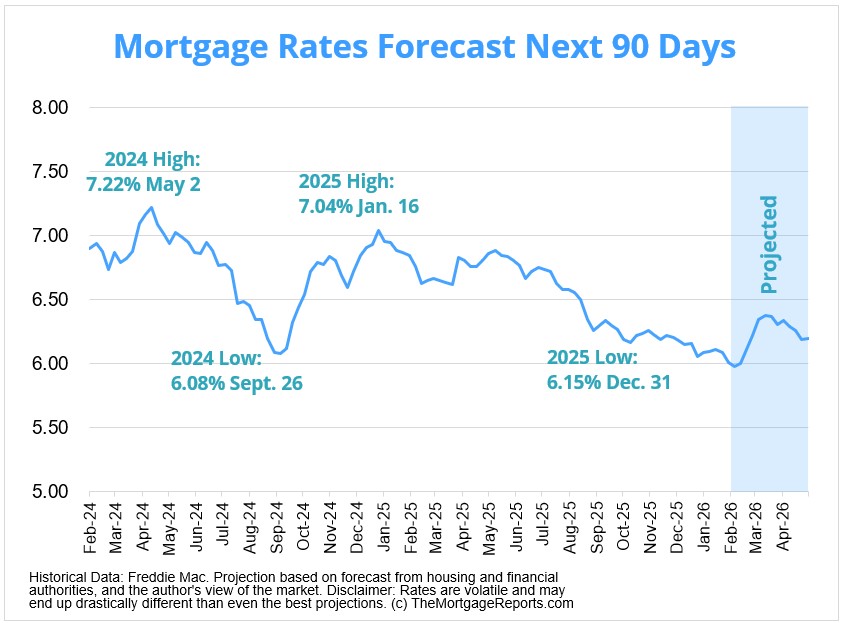
Mortgage interest rates forecast next 90 days
The Federal Reserve cut rates three times in late 2024 — in September, November, and December — but has held steady since then as progress on inflation stalled. Markets widely expect the Fed to stay put at its May 6-7 meeting, keeping the current policy rate unchanged. That leaves two more chances for action in the next 90 days: June 17-18 and July 29-30. Whether either of those meetings produces a cut depends almost entirely on what the incoming data show.
The May economic calendar is packed with reports that will shape those expectations. The BLS Employment Situation report, released the first Friday of the month, will signal whether the labor market is cooling enough to give the Fed room to move. The Consumer Price Index, typically published mid-month, offers the most closely watched read on inflation at the consumer level. And the BEA’s Personal Consumption Expenditures Price Index, due the last week of May, is the Fed’s own preferred inflation gauge. Taken together, these three releases will either build the case for a summer rate cut or take one off the table entirely.
Find your lowest mortgage rate. Start hereOf course, rates could rise or fall on any given week due to many factors or if another global event causes widespread uncertainty in the economy.
Mortgage rate predictions for May 2026
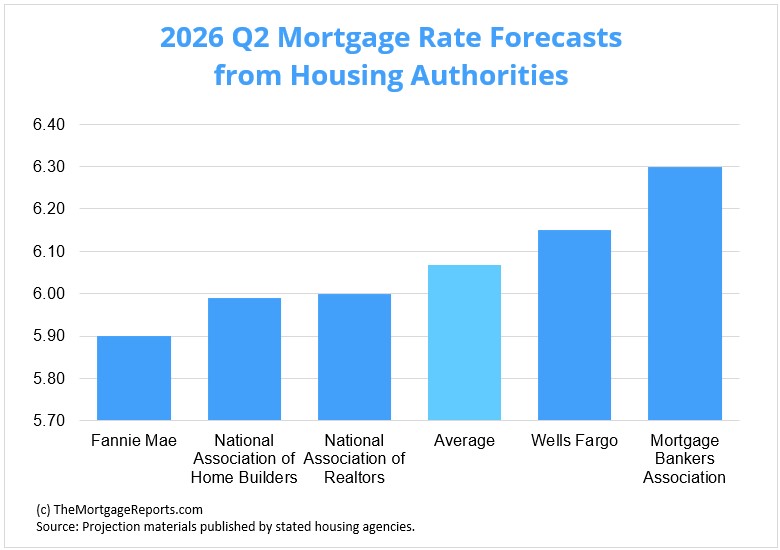
The 30-year fixed-rate mortgage averaged 6.37% as of Apr. 9, according to Freddie Mac. All five of the major housing authorities we looked at predict 2026’s second quarter average to finish below that.
Fannie Mae sits at the low end of the group, projecting the average 30-year fixed interest rate to settle at 5.9%. Meanwhile, the Mortgage Bankers Association had the highest Q2 forecast of 6.3%.
| Housing Authority | 30-Year Mortgage Rate Forecast (Q2 2026) |
| National Association of Home Builders | 5.99% |
| National Association of Realtors | 6.00% |
| Wells Fargo | 6.15% |
| Fannie Mae | 6.30% |
| Mortgage Bankers Association | 6.30% |
| Average Prediction | 6.148% |
Current mortgage interest rate trends
As of April 23, 2026, Freddie Mac’s weekly survey shows the average 30-year fixed mortgage declined to 6.23%.
The average 30-year fixed rate decreased to 6.23% on Apr. 23 from 6.30% on Apr. 16. Meanwhile, the average 15-year fixed mortgage rate dipped to 5.58% from 5.65%.
| Month | Average 30-Year Fixed Rate |
| March 2025 | 6.65% |
| April 2025 | 6.73% |
| May 2025 | 6.82% |
| June 2025 | 6.82% |
| July 2025 | 6.72% |
| August 2025 | 6.59% |
| September 2025 | 6.35% |
| October 2025 | 6.25% |
| November 2025 | 6.24% |
| December 2025 | 6.19% |
| January 2026 | 6.10% |
| February 2026 | 6.05% |
| March 2026 | 6.18% |
| April 2026 | 6.23% |
Source: Freddie Mac
After hitting record-low territory during the pandemic, mortgage rates surged through 2023 and 2024, with the 30-year fixed briefly averaging around 7.8%, according to Freddie Mac. Rates have since eased and currently sit near 6.3% — well below that recent peak and still under the long-term historical average, which has hovered above 7% over the past five decades. If you haven’t locked a rate yet in 2026, that context matters. You can still get a good deal by historical standards, especially if you have strong credit and take the time to shop multiple lenders for the best offer.
Dating back to April 1971, the fixed 30-year interest rate averaged around 7.8%, according to Freddie Mac. So if you haven’t locked a rate yet, don’t lose too much sleep over it. You can still get a good deal, historically speaking — especially if you’re a borrower with strong credit.
Just make sure you shop around to find the best lender and lowest rate for your unique situation.
Mortgage rate forecast by loan type
Loan-type trends were mixed this week, with 30-year fixed at 6.23% and 15-year fixed at 5.58%.
Find your lowest mortgage rate. Start hereWhich mortgage loan is best?
The best mortgage for you depends on your financial situation and your goals.
For instance, if you want to buy a high-priced home and you have great credit, a jumbo loan is your best bet. Jumbo mortgages allow loan amounts above conforming loan limits, which max out at $832,750 in most parts of the U.S.
On the other hand, if you’re a veteran or service member, a VA loan is almost always the right choice. VA loans are backed by the U.S. Department of Veterans Affairs. They provide ultra-low rates and never charge private mortgage insurance (PMI). But you need an eligible service history to qualify.
Conforming loans and FHA loans (those backed by the Federal Housing Administration) are great low-down-payment options.
Conforming loans allow as little as 3% down with FICO scores starting at 620. FHA loans are even more lenient about credit; home buyers can often qualify with a score of 580 or higher, and a less-than-perfect credit history might not disqualify you.
Finally, consider a USDA loan if you want to buy or refinance real estate in a rural area. USDA loans have below-market rates — similar to VA — and reduced mortgage insurance costs. The catch? You need to live in a ‘rural’ area and have moderate or low income to be USDA-eligible.
Mortgage rate strategies for May 2026
The current rate environment puts borrowers in a familiar spot: rates are low enough to make homeownership math work for many buyers, but the threat of sudden swings in either direction makes the lock-versus-float decision genuinely difficult. With key inflation data and a Fed decision all landing within the same month, May could either reinforce the status quo or reset expectations entirely.
Find your lowest mortgage rate. Start hereThat uncertainty is actually a useful signal. Rather than trying to time the market perfectly, borrowers are better served by treating today’s rates as a baseline and building a plan that accounts for movement in either direction. The strategies below are designed to help you act decisively if rates dip while protecting yourself if they don’t.
As always, the committee said it would adjust its policies as necessary — which could mean additional cuts, none at all or even possible raises.
Here are just a few strategies to keep in mind if you’re mortgage shopping in the coming months.
Be ready to move quickly
Indecision can lead to failure or missed opportunities. That holds true in home buying as well.
Although the housing market is becoming more balanced than the recent past, it still favors sellers. Prospective borrowers should take the lessons learned from the last few years and apply them now even though conditions are less extreme.
“Taking too long to decide to make an offer can lead to paying more for the home at best and at worst to losing out on it entirely. Buyers should get pre-approved (not pre-qualified) for their mortgage, so that the seller has some certainty about the deal closing. And be ready to close quickly — a long escrow period will put you at a disadvantage.
“And it’s definitely not a bad idea to work with a real estate agent who has access to “coming soon” properties, which can give a buyer a little bit of a head start competing for the limited number of homes available,” said Rick Sharga.
If mortgage rates continue on a downward trajectory, more and more buyers will likely enter the market after being priced out on the sidelines. Being decisive (and prepared) should only play to your advantage.
Shopping around isn’t only for the holidays
Since interest rates can vary drastically from day to day and from lender to lender, failing to shop around likely leads to money lost.
Lenders charge different rates for different levels of credit scores. And while there are ways to negotiate a lower mortgage rate, the easiest is to get multiple quotes from multiple lenders and leverage them against each other.
“For potential home buyers, it’s important to get quotes from multiple lenders for a mortgage, as rates can vary dramatically, especially during such a volatile period,” said Odeta Kushi.
As the mortgage market slows due to lessened demand, lenders will be more eager for business. While missing out on the rock-bottom rates of 2020 and 2021 may sting, there’s always a way to use the market to your advantage.
How to shop for interest rates
Rate shopping doesn’t just mean looking at the lowest rates advertised online because those aren’t available to everyone. Typically, those are offered to borrowers with great credit who can put a down payment of 20% or more.
The rate lenders actually offer depends on:
- Your credit score and credit history
- Your personal finances
- Your down payment (if buying a home)
- Your home equity (if refinancing)
- Your loan-to-value ratio (LTV)
- Your debt-to-income ratio (DTI)
To figure out what rate a lender can offer you based on those factors, you have to fill out a loan application. Lenders will check your credit and verify your income and debts, then give you a ‘real’ rate quote based on your financial situation.
You should get three to five of these quotes at a minimum, then compare them to find the best offer. Look for the lowest rate, but also pay attention to your annual percentage rate (APR), estimated closing costs, and ‘discount points’ — extra fees charged upfront to lower your rate.
This might sound like a lot of work. But you can shop for mortgage rates in under a day if you put your mind to it. And shaving just a few basis points off your rate can save you thousands.
Compare mortgage and refinance rates. Start here
Mortgage interest rate FAQ
Current mortgage rates are averaging 6.3% for a 30-year fixed-rate loan and 5.64% for a 15-year fixed-rate loan, according to Freddie Mac's latest weekly rate survey. Your individual rate could be higher or lower than the average depending on your credit score, down payment, and the lender you choose to work with, among other factors.
Mortgage rates are hovering around 6.3% and will likely stay close to that level in the near term, since the Fed is widely expected to hold rates steady at its May 6-7 meeting. The real catalysts to watch are the mid-month CPI report and the month-end PCE data, either of which could shift expectations for a summer rate cut and push rates meaningfully in one direction or the other. Borrowers who are ready to act should stay alert to those releases rather than waiting on a move that may or may not come.
Most housing economists expect mortgage rates to drift modestly lower through 2026, though the pace depends heavily on inflation data and how quickly the Federal Reserve eases its benchmark rate. As of early May 2025, the 30-year fixed sits around 6.3%, and the Fed is widely expected to hold steady at its May 6-7 meeting, which means any significant move in rates likely hinges on the mid-month CPI report and month-end PCE figures that could reshape expectations for a summer cut. Borrowers watching for a better rate environment should track those inflation releases closely, since they have the potential to push rates meaningfully in either direction.
Mortgage rates may rise in 2026. High inflation, strong demand in the housing market, and policy changes by the Federal Reserve in 2022 and 2023 all pushed rates higher. However, if the U.S. does indeed enter a recession, mortgage rates could come down.
Freddie Mac is now citing average 30-year rates in the 6% range. If you can find a rate in the 5s or 6s, you’re in a very good position. Remember that rates vary a lot by borrower. Those with perfect credit and large down payments may get below-average interest rates, while poor-credit borrowers and those with non-QM loans could see much higher rates. You’ll need to get pre-approved for a mortgage to know your exact rate.
For the most part, industry experts do not expect the housing market to crash in 2026. Yes, home prices are over-inflated. But many of the risk factors that led to the 2008 crash are not present in today’s market. Low inventory and massive buyer demand should keep the market propped up. Plus, mortgage lending practices are much safer than they used to be. That means there’s not a subprime mortgage crisis waiting in the wings.
At the time of this writing, the lowest 30-year mortgage rate ever was 2.65%. That’s according to Freddie Mac’s Primary Mortgage Market Survey, the most widely used benchmark for current mortgage interest rates.
Locking your rate is a personal decision. You should do what's right for your situation rather than trying to time the market. If you're buying a home, the right time to lock a rate is after you've secured a purchase agreement and shopped for your best mortgage deal. If you're refinancing, you should make sure you compare offers from at least three to five lenders before locking a rate. With rates currently near 6.3%, locking in sooner rather than later makes sense if you've found a competitive offer.
Refinancing may make sense if your current rate is above 6.75% to 7.00% and you plan to stay in your home long enough to recoup closing costs. At 6.23%, the current market primarily benefits borrowers who locked in during the rate peaks of 2023 and early 2024. If your existing rate is already in the low 6% range or below, the savings from refinancing at today's rates are unlikely to justify the costs.
It’s often worth refinancing for 1 percentage point, as this can yield significant savings on your mortgage payments and total interest payments. Just make sure your refinance savings justify your closing costs. You can use a mortgage calculator or speak with a loan officer to crunch the numbers.
Start by choosing a list of three to five mortgage lenders that you’re interested in. Look for lenders with low advertised rates, great customer service scores, and recommendations from friends, family, or a real estate agent. Then get pre-approved by those lenders to see what rates and fees they can offer you. Compare your offers (Loan Estimates) to find the best overall deal for the loan type you want.
What are today’s mortgage rates?
Mortgage rates remain elevated by historical standards, but borrowers can almost always find a better deal by shopping around. Connect with a mortgage lender to find out exactly what rate you qualify for.
Time to make a move? Let us find the right mortgage for you1Today's mortgage rates are based on a daily survey of select lending partners of The Mortgage Reports. Interest rates shown here assume a credit score of 740. See our full loan assumptions here.
Selected sources:
- https://www.federalreserve.gov/monetarypolicy/fomccalendars.htm
- http://www.freddiemac.com/research/datasets/refinance-stats/index.page