If you want to be notified when I write something new on The Mortgage Reports, sign up for free daily email alerts or subscribe to the free RSS feed.

FHA Mortgage Insurance Premiums To Rise In October : Should You Act Now, Or Should You Wait?

Posted on August 16, 2010
Filed under FHA Mortgages

FHA premium comparison October 4 2010

For the second time in 4 months, the FHA is changing the way it charges mortgage insurance. The change is forcing homeowners and home buyers using FHA financing to make a monetary decision -- use the current system for FHA mortgage insurance, or to wait for the new one to take effect?
The answer roots in mathematics, but first, some FHA background.

How FHA-Insured Mortgages Work

Most people forget -- the FHA is not in the business of making loans to homeowners. Rather, the FHA insure loans that lenders make to borrowers. The FHA puts out a set of guidelines says to banks that "so long as your borrowers meets these requirements, we will insure the loans you make to them."

Now, banks don't expect their FHA-backed loans to go bad, but when their loans default, the FHA steps in and makes payment on them similar to how any insurance-type company would operate.  And, to fund these claims, the FHA uses its insured borrowers' own money.

Homeowners backed by the FHA pay into the FHA insurance fund in two ways:

  1. With a one-time, upfront payment at closing called Upfront MIP
  2. With an monthly, pro-rated annual payment called Annual MIP

Mortgage insurance premiums kick off a lot of money and the FHA has been self-funded for years without issue.  However, as FHA home loan defaults have climbed recently, so have insurance payouts to lenders.  It's put a ginormous strain on the FHA's solvency.

For example, in September 2008, the FHA held $19 billion in reserves. Today, that number is $3 billion.

In the FHA's own words, the groups reserves are "perilously low".

Summarizing The FHA Mortgage Insurance Changes

As a means to help refill its coffers, therefore, the FHA is changing its upfront and annual mortgage insurance premium structure.  It's the second tweak of 2010 and the changes apply to FHA case numbers issued on or after October 4, 2010.

Under the updated mortgage insurance program, assuming a 30-year fixed rate FHA mortgage with at least 5 percent equity:

  • Upfront MIP drops to 1.000% of the amount borrowed from 2.250%
  • Annual MIP increases to 0.850% of the amount borrowed from 0.500%

For homeowners using an FHA-insured mortgage, the upfront cost of the loan will drop by a lot, but the long-term costs of the loan will grow.

Using a $200,000 mortgage as an example, upfront MIP falls to $3,000 from $7,750; monthly MIP jumps to $212.50 from $125.00.  The FHA expects the change to yield an additional $300 million in premiums monthly.

Work The Change In FHA Premiums To Your Advantage

Homeowners wanting an FHA-insured mortgage should remember the October 4, 2010 implementation date.

If your FHA case number is assigned on, or after, that date, you will get the 1 percent upfront cost + the 85 basis points each year thereafter. If it's assigned prior to, you'll get the 2.25 percent + 50 basis points.

Or, simplified:

  • Current system : Big upfront costs, low long-term costs
  • New system : Low upfront costs, big long-term costs

So which is best, then?  It depends on your timeline.

The mathematical break-even point on the current FHA system versus the new one is Month 43. If you know you'll sell or refinance in fewer than 3 years, 7 months, you should wait to start your mortgage application until after the October 4, 2010 changeover.

On the other hand, if this is your "last home for life", give that application as soon as possible!

The math works for all loan sizes, too -- from $75,000 all the way up to the FHA loan limits for your area.

Start Your FHA Home Loan Application Online

If you’re unsure of how FHA mortgage premiums work, or how the change will affect your payments, etc, just . I answer all of my own emails and will get back to you quickly.

NOTE : The FHA originally announced an implementation date of September 7. That date was later amended to October 4, 2010.


Dan Green is an active loan officer. Email or call 513-443-2020. Dan is on Twitter at @mortgagereports.

Tags: Breakevem, FHA, HUD, MIP, Mortgage Insurance, UFMIP

MailChimp

Comparing FHA And Conventional Mortgages With Less Than 20% Downpayment

Posted on October 20, 2009
Filed under FHA Mortgages

PMI Defaults 2007-2009Private Mortgage Insurance is an insurance policy that is paid by homeowners for the benefit of lenders.

It's required for all conventional-mortgage homeowners whose loans exceed 80% loan-to-value.

Similar to homeowners insurance, private mortgage insurance gets "cashed in" when a loss occurs. In the case of the former, the loss may be storm damage; the latter, mortgage default.

With foreclosures proliferating, PMI defaults are up 26 percent over last year and double the levels from 2007.  Private mortgage insurers are paying out on many more claims than was expected and, as a result, are booking huge losses.

Homeowners are about to pay the price. To shore up balance sheets and protect against future losses, mortgage insurers have raised insurance rates and toughened underwriting guidelines.

Some of the changes we're seeing include:

  • Minimum FICO requirements of 720 based on loan-t0-value
  • Maximum debt-to-income ratios of 41%, regardless of Fannie Mae approval
  • Loan size limitations, based on the health of the local real estate market

And, of course, insurance premiums are increasing for everyone.

It's a 2-pronged attack that will make a less-than-20%-downpayment more costly for Fannie Mae- and Freddie Mac-backed mortgage.

The alternative is to look to the FHA for a mortgage.  There's 2 advantages here.

First, as compared to PMI rates, FHA mortgage insurance looks cheap.  A $200,000 FHA home loan with 10% down can save as much as $400 in insurance costs.  With 5% down, that number grows to $1,040 per year.

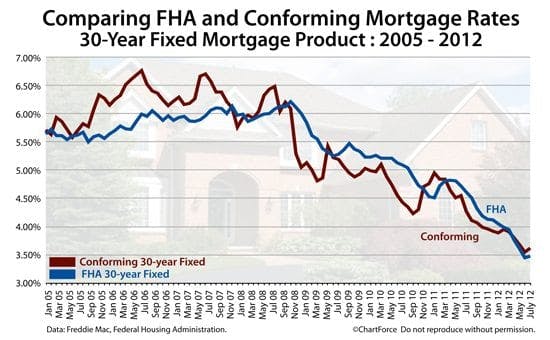
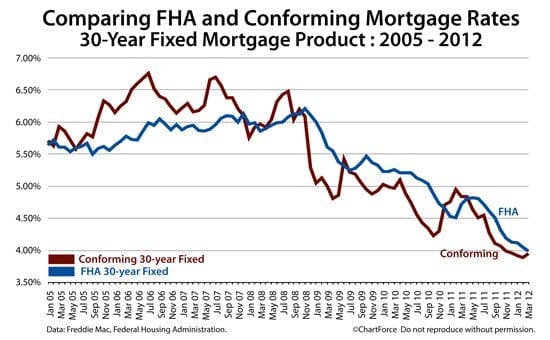
Second, with FHA mortgage rates running neck-and-neck with conventional ones, there's a lot of days when 30-year fixed mortgage rates are cheaper in the FHA market versus the conventional one.

The downside of FHA is that the government puts up to 1.750 percent insurance fee into your loan at the time of closing.  It's a cost that doesn't exist in the conventional world and, for some people, the fee makes FHA an imperfect fit.

The key is to talk with your loan officer about Conventional and FHA mortgages to make sure you're making the right choice.

For help with your FHA vs Conventional decision, anytime with the details of your situation.  I answer all of my own emails and am happy to help you with what I know.

Plus, my rates are really good.


Dan Green is an active loan officer. Email or call 513-443-2020. Dan is on Twitter at @mortgagereports.

Tags: FHA, MIP, Mortgage Insurance, PMI

Live Rate Quotes

Required fields are marked with*