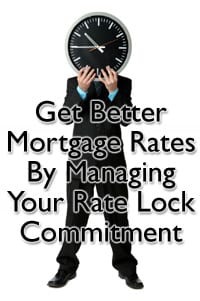
 It pays to know The Mortgage Rate Game.
How To Reduce Your Loan Fees
When it comes to shopping for mortgage rates, to paraphrase Doris Day, que sera, sera; whatever will be with mortgage rates will be.
Rates are a function of Wall Street. They’re beyond our control. However, there are ways to make sure you’re getting the lowest rate possible.
There are four of them, in fact.
- Get a higher credit score
- Make a larger downpayment
- Get higher credit score and make a larger downpayment
Or, you can follow Path #4 — pick a smarter closing date.
Click here to get a mortgage rate quote
.
Mortgage Rate Locks: A Bank’s Gamble
Let’s talk about Rate Lock Commitments.
A Rate Lock Commitment is a bank’s promise to honor a specific mortgage rate for a specific period of time. It’s a contract, of sorts, in which the lender says: “Provided you close on your loan in the next however-many days, we guarantee your locked mortgage rate for you.
From a bank’s perspective, rate locks are a gamble.
This is because the bank is promising you an interest rate today that won’t be delivered for some number of days. The more days there are between the lock date and the delivery date, the greater the chance that the bank “guessed wrong”.
For a sports analogy, it’s like picking trying to pick a division winner at the start of the season. There’s a lot of time between Opening Day and the Day 1 of the playoffs, and a lot of things can go wrong or change.
The longer the season, the less accurate the predictions.
With respect to mortgages, it’s why longer rate lock commitments often require with higher interest rates, higher fees, or both. Guessing where mortgage rates will be in the future is a dangerous game so banks hedge against “time risk”. And they often pass those costs to you.
Click here to get a mortgage rate quote
.
How The Rate Lock Game Is Played
The Rate Lock Game is pretty simple. It starts with the basic concept that rate locks are made in 15-day increments. You can choose from any of the following: 15-day rate lock; 30-day rate lock; 45-day rate lock; 60-day rate lock; et cetera.
Using that concept of “time risk” again, the longer your rate lock is, the higher your mortgage rate will be.
- 15-day rate lock : 1/8 percent lower than the 30-day rate lock
- 30-day rate lock : The basis for all other pricing
- 45-day rate lock : 1/8 percent higher than the 30-day rate lock
- 60-day rate lock : 1/4 percent higher than the 30-day rate lock
In a Real World Example, if you went to contract this week and set your closing date for Monday, March 5, that would be 48 days from now. You would need a 60-day rate lock and your mortgage rate would be raised 1/8 percent.
However, if you just moved your closing date one business day sooner — to Friday, March 1 — you’d get a 45-day lock and a lower mortgage rate. This one-day change will drop $15 off your monthly mortgage payment on a $200,000 home loan.
Time to make a move? Let us find the right mortgage for you
.
Be Smart About Your Closing Date
When you choose a better closing date, you keep your mortgage rates down. So, before you write that contract, consider how “time risk” will change your mortgage bottom line.
The less time you’ll need to close, the more money you should expect to save.
To get started on with a rate quote, use my online mortgage rate quote form.