If you want to be notified when I write something new on The Mortgage Reports, sign up for free daily email alerts or subscribe to the free RSS feed.

The Falling, Long-Term Cost Of A 30-Year Fixed Rate Mortgage

Posted on August 30, 2010
Filed under Mortgage Planning Ideas

Long-term cost of 30-year fixed rate mortgage 2010

Each Thursday, Freddie Mac publishes a "national" mortgage rate in its Primary Mortgage Market Survey.  Nevermind its flawed methodology -- the Freddie Mac survey does an excellent job of showing whether mortgage rates are rising or falling.

Since early-April, rates are down and down big.

A 4-Month Rally In Mortgage Rates

Going back 18 weeks, week after week, the story is the same. Mortgage rates are falling and making new, all-time lows. You can't open the paper or watch the news without hearing about it.

As for why it's happening, the logic is pretty basic. When the economy hits a rough patch, or when uncertainty rides high, investors prefer to put money somewhere safe and bonds backed by the U.S. government fit the bill.  The U.S. government has never defaulted on debt and its backing is considered a guarantee of repayment. Ergo, U.S. government-backed debt is "riskless".

When investors move into government debt, it's often called a "flight to quality". Mortgage bonds gain on it.  This is because mortgage-backed bonds have the implicit backing of the U.S. government and are considered "safe".

The added demand leads bonds prices higher and, because bond yields move opposite of price, mortgage rates lower.

On April 8, 2010, the average, 30-year fixed mortgage rate was 5.21% -- the high point for 2010.  Since then, however, fears of a renewed recession and general economic malaise have contributed to an ongoing, seemingly-endless rally. There's been very little "good news" to reverse the slide, the constant negativity helped to lower mortgage rates by almost an entire percentage point.

Not since ever have conforming 30-year fixed mortgage rates been this low in Cincinnati.

The Falling Cost Of A 30-Year Fixed Rate Mortgage

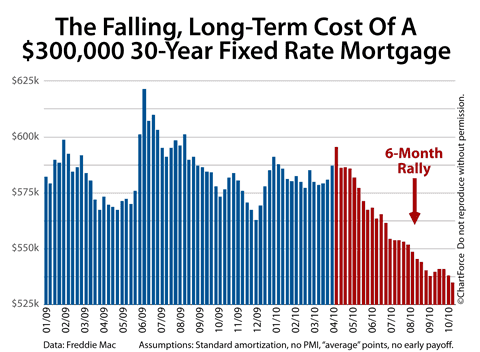
Today's low rates have reduced the long-term cost of ownership by a lot.

To validate the math, we look at the interest paid over the life of a loan, plus its upfront costs (i.e. "points"). Naturally, the higher the interest rate, the more expensive the loan's long-term cost.

Comparing 1994 to today:

  • In 1994, at interest rates of 9.375%, it cost $900,000 to repay off a $300,000 loan
  • In 2010, at interest rates of 4.250%, it costs $540,000 to repay off a $300,000 loan

That's a three-hundred-sixty-thousand dollar difference in just 16 years.  And, 1994 isn't that long ago, either.  There's plenty of people in Cincinnati who've lived in their same home for 16 years. If these same people bought a home today -- at today's rates -- the cost of homeownership would be 38% less. That's huge.

Furthermore, as compared to May 1, 2010 -- the day after the $8,000 federal home buyer tax credit expired -- today's cost of carrying a 30-year fixed rate mortgage to term is lower by $45,500.

That's irony right there.

Mortgage Rates Are Low. Lock In Already.

When we talk about home affordability, it's stuff like this; long-term mortgage costs are down; home values are troughed; lumber and labor are cheap.  It's an excellent time to buy or build a home, all things relative.

It's also an excellent time to refinance.  If you bought a home between 2006 and the early-2010, you should really look at rates vis-a-vis your loan term costs of ownership. Not every family will save 38% long-term on their mortgage, but some of you will.

Get a free, no-obligation quote on your mortgage, .  Or, call me.  I answer my calls and answer all my own emails.

Mortgage rates change all the time so that 4.250 30-year fixed rate might not be available for you if you wait. Therefore, if it makes financial sense to refinance today, do it.


Dan Green is an active loan officer. Email or call 513-443-2020. Dan is on Twitter at @mortgagereports.

Tags: 30-Year Fixed Rate Mortgage, Discount Points, Freddie Mac, mortgage rates, PMMS, So I Married An Axe Murderer

MailChimp

The Untimely Timing Of The Freddie Mac Primary Mortgage Market Survey

Posted on June 22, 2009
Filed under On Mortgage Rate Movement

The Freddie Mac Primary Mortgage Market Survey is expired before it's publishedTo a consumer, one of the most difficult facets of shopping for a mortgage is figuring out just what mortgage rates are doing at any given time.

Despite countless websites and blogs devoted to the topic of mortgage, the most important part of a person's research -- the darn price -- can't be found hardly anywhere online.

It's a horrifying revelation for people vis-à-vis the way we've all been trained to use the internet.  After all, we're conditioned to use the internet as a means to eliminate information asymmetry; to know the price before we ever step foot in the store, so to speak.  That way, we can be sure we're negotiating the best possible deals for ourselves.

Except it doesn't work like that for mortgages.  Prices are elusive.

Through the course of doing mortgage-related research online, most people actually learn a lot about home loans.

  • They learn that mortgage rates are based on mortgage-backed bonds and not the 10-year Treasury Note
  • They learn the intricacies of how FHA Streamlines work and about MIP refunds
  • They learn how Conforming Loan Limits apply to their specific zip code

Beyond that, however, it's an information abyss.

When you want to know what mortgage rates are doing, there's no crawler you can watch on CNBC.  There's no ticker symbol to track on Google Finance.  There's not even a section on the Investor’s Business Daily website for it.  So, in the absence of timely mortgage rate information -- unfortunately -- people turn to whatever information they can find.

And that's when the trouble starts.

One of the most widely-recognized mortgage rate surveys is the Freddie Mac's Primary Mortgage Market Survey.  Published since 1971, it's the basis for national mortgage rate news stories, for Home Affordability studies, for congressional research, and about anything else mortgage-rate related.

The Freddie Mac survey gets a lot of ink in the nation's newspapers and, for most people, it's the only news they hear about whether mortgage rates are rising or falling.

The study is flawed in a big way, however.  Huge.  The problem is with the survey's methodology.

According to Freddie Mac, Primary Mortgage Market Survey results are collected from survey participants Monday through Wednesday, and then published to the public Thursday.  The survey is grouping mortgage rates into a static data point when, in fact, they're anything but static.

It's an egregious example, but across those 3 days last week, lenders issued 9 separate rate sheets with a 1/2 percent spread between them. Survey results were destined to be skewed depending on which day survey participants checked back with Freddie Mac.

Furthermore, because Freddie Mac embargoes the survey results until Thursday morning, there's even another day through which mortgage rates can change.

Again, looking at last week, markets sold off with force Thursday morning, causing rates to rise 0.375 percent before noon.  By the time the Freddie Mac survey was published, therefore, it had zero practical application to rate shoppers in Cincinnati or anywhere else.

The Freddie Mac Primary Mortgage Market Survey reported "average mortgage rates" well below what was actually available at the time its publication.

So, for active home buyers and people wanting to refinance, it's not tough to find information about mortgages, it's only tough to get information about mortgage rates.  Specifically, mortgage rates as they apply to your personal profile.

One solution is to watch my Twitter feed at http://twitter.com/mortgagereports.

If you've never been on Twitter, it's a low-impact workout.  Sign up for a free account, follow me (@mortgagereports), and then check back as often as you'd like.  Whenever you re-visit my Twitter page, you'll see the last series of updates and you can get a feel for whether rates are improving or worsening.  I update the feed several times per day -- more often when markets are turning quickly.

If after some time you find that my Twitter feed isn't "personal" enough for you, and ask to be on the Rate Watch list.  I'll reply back with a request for some basic information and we'll get a feel for today's interest rates as they apply to what you've got going on.  Then, if everything makes sense for you, we can put a Rate Lock agreement in place at your request so that when your target interest rate hits, we'll be ready to lock it on your behalf.

Mortgage rates move quickly and you can't wait for Freddie Mac to tell you what they are.  It's the most heavily-relied upon sources of mortgage rates and it's outdated before it's ever published.  Instead, consider relying on me.


Dan Green is an active loan officer. Email or call 513-443-2020. Dan is on Twitter at @mortgagereports.

Tags: Freddie Mac, PMMS, Pretty Woman, Tom Leppard

Mortgage Rates Falling Are Half The Story. What About The Mortgage Fees That Go With Them?

Posted on January 14, 2009
Filed under On Mortgage Rate Movement

Freddie Mac Primary Mortgage Market Survey -- comparing rates and fees in 2008

Each week, Freddie Mac publishes its Primary Mortgage Market Survey, a report of the nation's average mortgage rate-and-fee structure.  The media then grabs Freddie's press release and reports it to Americans in its newspapers, websites and television program.  It's through these channels that most Americans get their mortgage rate "news".

It's too bad for Americans because the press over-simplifies the survey.  Freddie Mac gives them two pieces of information -- (1) mortgage rates, and (2) mortgage fees -- but the press only reports on one of them -- rates.

Check out these headlines:

Factually, the headlines are accurate.  But, it's the second element of the press release that puts the headlines in context.  Sure, rates are down, but the fees lenders charge to get those rates is up.  By a lot.

According Freddie Mac's survey, mortgage rates were 0.38% cheaper at year-end versus the previous all-time low that was set in January 2008.  However, the average fees required to get that published rate lept by 0.400 percent over the same period of time. 

Let's put this in context, applying the numbers to a real-life, $300,000 conforming mortgage.

  • January 2008 : $1,699 monthly payment, $1,200 loan fee
  • December 2008: $1,628 monthly payment, $2,400 loan fee

A homeowner relocating to Cincinnati, for example, is saving $71 per month at today's Freddie Mac-published mortgage rates, but has to pay an extra $1,200 to do it. That makes for a 17-month "break-even" schedule -- hardly awesome.

So, we talk about this to remind you -- the headlines rarely tell the whole story.  Mortgage rates are lower, but the fees required to get them are not.  The chart above proves it.


Dan Green is an active loan officer. Email or call 513-443-2020. Dan is on Twitter at @mortgagereports.

Tags: MSM=FAIL, PMMS

Live Rate Quotes

Required fields are marked with*