If you want to be notified when I write something new on The Mortgage Reports, sign up for free daily email alerts or subscribe to the free RSS feed.

8 Ways To “Un-Approve” Your Mortgage By Mistake

Posted on March 5, 2010
Filed under On Mortgage Approvals
Read the complete post

Thanks for visiting The Mortgage Reports. To stay absolutely current on mortgage markets and important guideline changes, be sure to take my free daily email alerts.

8 Ways You Can Unwittingly Sabotage Your Mortgage ApprovalSometimes, it's not getting the mortgage approval that's so tough. It's keeping the approval.

Short Sales Are Slow To Close

Unless you're applying for a conventional mortgage or going FHA, getting to the closing table can take up to 2 months, depending on the speed of appraisal, bank signoff, and other factors.

It's especially bad with short sales, foreclosures and short refis.

During those 60 days, a lot can happen to a person that changes their underwriting disposition.  For example, one could lose their job, get injured, or have a home damaged by storm.

And, the more time there is between application and closing, the more likely a catastrophic event is to occur

Of course, catastrophe tends to lead to a mortgage turndown and,  sometimes, bad things just happen.  However, there are things that you can plan for; things within your control.

Good Behavior Matters in Mortgages

Mortgage approvals are fragile, living things and nothing's done until it's done. Good behavior matters.

Keeping that in mind, here are 8 things you should absolutely not do between the date of application and the date of funding.  I've been doing this long enough that I can say with certainty: Ignore these rules at your own peril.

Bad Mortgage Behavior, Defined

  1. Don't buy a new car or trade-up to a bigger lease
  2. Don't quit your job to change industries or start a new company
  3. Don't switch from a salaried job to a heavily-commissioned job
  4. Don't transfer large sums of money between bank accounts
  5. Don't forget to pay your bills -- even the ones in dispute
  6. Don't open new credit cards -- even if you're getting 20% off
  7. Don't accept a cash gift without filing the proper "gift" paperwork
  8. Don't make random, undocumented deposits into your bank account

Now, it may be impractical to have follow every rule to the letter.  I know that.  For example, if your car lease is expiring,  you have to do what you have to do.  But before renewing the lead, check with your loan officer to see if renting a car for the short-term would be a better solution instead.

It may prove more costly today, but it could be much, much cheaper over the next 30 years of your mortgage.

The same goes for accepting cash gifts from parents.  There's a right way and a wrong way to accept a cash gift and doing it the wrong way may preclude your ability to use the gift as a source of downpayment.

Tread Carefully And Keep Your Credit Scores High

There are a bevy of "gotchas" in Mortgageland and with underwriting times getting longer, it's more likely that the average applicant will trip into one.

Following these 8 rules, though, is a good start.


Dan Green is an active loan officer. Email or call 513-443-2020. Dan is on Twitter at @mortgagereports.

Tags: Gift Letters, Mortgage Approvals, Underwriting

SEO Copywriting Made Simple
I use Scribe to improve my blog SEO

9 Things To Watch While Waiting For Mortgage Rates To Dip A Bit More

Posted on December 9, 2009
Filed under On "Float" vs. "Lock"
Read the complete post

Don't mess with the Mortgage Gods -- it's bad karmaOne things is clear.  4.500 percent with roughly 1 point is the mortgage market's line-in-the-sand de l'année.

The 30-year fixed mortgage rates has troughed at that exact point 5 times in the last 13 months :

  1. Late-November 2008
  2. Early-January 2009
  3. Mid-March 2009
  4. Late-May 2009
  5. Early-December 2009

It's an amazingly low rate as compared to history but what's bedeviling is that rates can't seem to break lower.  Every time markets hit the "all-time low", they bounce back higher.

The storyline is well-covered by the press.  Mortgage rates move higher, then experts predict they'll never come down again, then mortgage rates come down, then the experts say "this is the last time".

The impact on Cincinnati's homeowners is palpable.  Whenever mortgage rates rise off that floor, versus feeling an urgency to lock, they choose to wait for a fall.  And why shouldn't they?  It's a strategy that's worked very well since last year and has likely saved a lot of families a lot of money.

But just because the strategy has worked doesn't make it a good idea.  Actually, it's the opposite of a good idea, not the least of which is that it tempts the mortgage rate gods to screw you.

See, aside from mortgage rates, there's other factors that account for your final mortgage approval and none of them are within your control.  Rates may fall back to 4.500 percent at some point in the future, but when they do, you might not be able to take advantage.  Here's 9 things that could go wrong from a much longer list.

1. You could unexpectedly lose your job.  More than 7,000,000 people have been fired in the last 2 years and employment data is still net negative month-to-month. No job, no mortgage approval. Period.

2. Mortgage lenders are reducing loan-to-value limitations.  Suddenly, having a 20 equity stake in your home may not be enough to qualify.  Sometimes, you need 25 percent or more.  On jumbo loans, that number can be even higher.  Homeowners with jumbo and non-owner occupied mortgages are especially susceptible here.

3. Your home could be damaged in a storm. Weather is as unpredictable as mortgage rates and Mother Nature can be a mean one.  Just ask the folks in Chicago who expect up to 10 inches of snow in parts of the suburbs today.  The problem here is that once a state Governor requests federal aid for a storm, mortgage lenders put their closings on hold pending complete home re-inspections.  A damaged home doesn't get its new mortgage.

4. Mortgage insurance rates could rise. Private mortgage insurers lost billions in 2008 and have thrice raised premiums to even up their balance sheets.  Some are returning to profitability but it's likely that PMI rates will rise again. Higher PMI costs offset proposed monthly savings.

5. You could fall ill or get injured. Medical reasons are the second-most common trigger for home foreclosures next to income curtailment (See #1).  If illness keeps you from working, or leads to a long-term disability, your mortgage approval chances drop dramatically.  Nobody ever expects to get sick.

6. Banks could tighten lending guidelines. Well, we already know this is happening. FHA, conforming and niche lenders are still fine-tuning their respective lending models to protect against losses in 2010 and beyond.  The result: Applicants that qualify for a mortgage today may not qualify for one tomorrow.

7. Your home's value could fall. Foreclosures and "fire sales" lower the Fair Market Value of every home in the immediate area.  A home similar to yours that sells for less than yours is going to lower your home's value on paper. Lower valuations lead to higher LTVs and, often, higher mortgage rates.

8. Your credit score could fall unexpectedly. Credit scores are meant predict the likelihood of mortgage default and the model appears to have failed.  As a result, credit bureaus are making tweaks.  Carrying high balances or opening new tradelines appears to be more damaging to credit scores than it used to be.  Lower credit scores means higher mortgage rates.

9. Mortgage rates could rise, not fall. Look, nobody knows what rates will do tomorrow.  Anyone who says they do is lying.  The only thing predictable about mortgage rates is that they're unpredictable.  Take what you can, when you can.  You can always refinance again later.

And, if you want to throw a 10th reason in there for good measure, use this: It's a pain in the arse for the average person to track mortgage rates and at-work productivity can really suffer while you try.

The sooner you commit to a rate, the sooner you can move on with your life.

To get started with your approval, or just to check rates, or give me a call. I answer all my own emails and I like to work with my readers. Plus, my rates are really good.


Dan Green is an active loan officer. Email or call 513-443-2020. Dan is on Twitter at @mortgagereports.

Tags: Beached Whale, Mortgage Approvals, Mortgage Karma, PMI

In A Market Like This, How Do You Get A Home Loan Approved, Anyway?

Posted on July 22, 2009
Filed under On Mortgage Approvals
Read the complete post

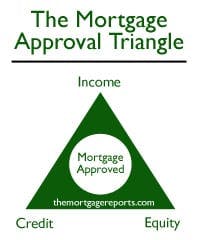
The Mortgage Approval Triange -- Income, Equity and CreditAs strict as mortgage underwriting has been lately, it may seem that there's a magic formula to getting approved. Truth is, there's not.

Getting approved for a mortgage is the same as it ever was, just with higher hurdles. Satisfy the Mortgage Income-Equity-Credit Triangle and everything else is cream cheese.

The Income-Equity-Credit Triangle is the basis for most mortgage approvals -- conforming, FHA, Jumbo and otherwise.  The more strength that an applicant shows across each of the three elements, the more likely that person is to get approved in underwriting.

The 3 corners of the mortgage approval triangle are:

  • Income : The relative strength of monthly taxable income versus monthly household debt.  This is more commonly called debt-to-income, or DTI.
  • Equity : The percentage of equity in a home. This is more commonly called loan-to-value, or LTV.
  • Credit : The middle of the three credit scores, as reported by Experian, Equifax, and TransUnion.

Now, for every mortgage product on the market, applicants must meet or exceed a series of minimum requirements in order to gain an approval.  These requirements are more commonly called "guidelines" and they've been been dramatically toughened over the past 18 months.

This is one reason why getting approved for a mortgage has been challenging lately. Meeting the minimum requirements is like hitting a target with a bow-and-arrow and the smaller the bulls-eye, the harder it is to score.

Furthermore, the bulls-eye's size varies from loan program to loan program. It's easier to qualify for a conventional 30-year fixed mortgage than it is for, say, the Fannie Mae 5-10 Properties Program.

The Mortgage Approval Triangle -- How Compensating Factor impact mortgage approvals

Whenever the 3 elements exceed minimum requirements -- as shown in the illustration at top -- the "Morgage Approved" bulls-eye is fully visible.  This tells us that the applicant's home loan is likely to be approved in underwriting.

Not every mortgage applicant will show three-category strength, though, and that's okay, too.

Weakness in one of the 3 areas can be compensated for if the applicant can show exceptional strength in the two other categories.  In essence, the applicant's strengths counter-balance his weakness, and a mortgage approval can be just as likely.

In the industry, it's called "compensating factors" and is illustrated by the graphic at right.

Although income levels are less than ideal, credit scores and home equity percentages are stronger-than-necessary, leaving the "Mortgage Approved" bulls-eye in full view.  This applicant's home loan is likely to be approved in underwriting.

Mortgage Denial -- No Compensating Factors

Now for that same applicant, if credit scores and home equity percentages are not strong, the bulls-eye falls out of range.  With no compensating factors, on paper, the loan looks primed to default and it's going to be denied in underwriting.

This is illustrated at right.

And, unfortunately for homeowners, mortgage lenders are putting less faith in compensating factors these days than they used to.  It's another reason why mortgage approvals are tougher to come by.

In response to spiraling mortgage defaults, Fannie Mae, Freddie Mac and the FHA all drew lines in the sand with respect to certain minimum applicant requirements.

For example, debt-to-income levels have a "hard-stop" in the 40-percent range.  Anything above that triggers a turn-down.  This holds for everyone -- even the multi-millionaire with 20% loan-to-value.

Hard stops are a cause for consternation among both homeowners because, in some respects, it's like common sense is getting thrown out the window.  "Of course I can repay this mortgage," an applicant will say.  "Look at my bank accounts.  Look at my payment history.  Look at my equity.  I'm the perfect borrower!"

Sadly, underwriters don't care much for that.  A hard stop is a hard stop and the mortgage application will be turned down because the paper file fails to meet minimum mortgage guidelines.

So, in reviewing the mortgage approval process, nothing's really changed over the past few years.  Appraisals are under more scrutiny, income must absolutely be verified, and there's more steps from start-to-finish but the process itself is exactly the same.

The only thing that's different is the size of the bulls-eye.  It's been shrunk.  And trying to jam yourself into the smaller bulls-eye isn't always your best answer.  Oftentimes, there's a better-fitting product with rates just as low.

So, if you're having trouble getting a home loan through underwriting or want to talk about your qualifications, anytime and we can talk about what's possible for you.


Dan Green is an active loan officer. Email or call 513-443-2020. Dan is on Twitter at @mortgagereports.

Tags: Beetlejuice, Love Potion #9, Mortgage Approvals, Talking Heads, Teen Wolf

Live Rate Quotes

Required fields are marked with *