If you want to be notified when I write something new on The Mortgage Reports, sign up for free daily email alerts or subscribe to the free RSS feed.

Spring 2010 FHA Changes : Higher Fees, Bigger Downpayments, And More Mortgage Insurance

Posted on February 25, 2010
Filed under FHA Mortgages
Read the complete post

Thanks for visiting The Mortgage Reports. To stay absolutely current on mortgage markets and important guideline changes, be sure to take my free daily email alerts.

FHA guidelines include higher loan costs and bigger downpaymentsLife as an FHA borrower is getting tougher.

In an effort to shore up its flailing balance sheet and dwindling capital reserves, the Federal Housing Authority is rolling out sweeping financial changes. FHA borrowers have to look better on paper and be better credit risks.

Mortgage insurance premiums are rising, too.

Changes Effective April 5, 2010

In its official announcement, the FHA said its trying to better position itself to "manage its risk while continuing to support the nation’s housing market".

The changes are effective with case numbers assigned starting April 5, 2010.

One widely speculated change wasn't made -- the increase of the FHA minimum downpayment.  Homebuyers in Cincinnati, Chicago and elsewhere can still buy with just 3.5 percent down.  However, the group did roll out a number of other changes, including:

  • An increase in Upfront MIP from 1.75 percent to 2.25 percent
  • A reduction in maximum seller contributions from 6 percent to 3 percent
  • A Congressional request to increase monthly mortgage insurance premiums

Furthermore, the FHA's new guidelines institute a minimum FICO requirement of 580 to make the minimum 3.5% downpayment, requiring 10 percent for any applicant whose credit score falls below that level.

2010: The Year Of Investor Overlays

But, just because the FHA allows 580 FICOs, banks don't have to allow it.

The official term here is "investor overlay". It's when that banks use Federal Housing Authority guidelines as a starting point for their own set of underwriting rules which are often more strict.

And banks have a good reason for making investor overlays.

In January, the FHA subpoenaed 15 lenders -- including the well-respected 1st Advantage Mortgage in Lombard, Illinois -- because of abnormally-high FHA default rates.  The act was a shot across the bow, it appears, because more lenders have been shut down since.

The FHA made a loan performance benchmark and if a  bank's defaults exceed the mean by x number of sigmas, said bank loses its FHA license. Period.

Expect FHA investor overlays to be a running theme of 2010.

A Mortgage Denial May Not Be Permanent

Guidelines will vary from bank-to-bank as lenders take a more active role in managing their originated mortgages.  What gets FHA-approved Bank of America, for example, may not be FHA-approved at Wells Fargo.

Many FHA loans will be denied in 2010 simply because the applicant applied at the wrong bank.

If your mortgage has been denied or you just want to have the best chance of being approved possible, call or with some notes on your situation. I work for Waterstone Mortgage -- a HUD-approved lender.  We underwrite and fund FHA mortgages from our own accounts, and work with the nation's largest investors as an approved conduit.

In other words, apply once and you'll be automatically aligned with the bank with the best pricing plus least amount of overlays. That's what I do for you as your loan officer.


Dan Green is an active loan officer. Email or call 513-443-2020. Dan is on Twitter at @mortgagereports.

Tags: FHA Mortgage, Investor Overlay, MIP, Upfront MIP

SEO Copywriting Made Simple
I use Scribe to improve my blog SEO

FHA Mortgage Rates Are Lower Than Conventional Mortgage Rates

Posted on November 9, 2009
Filed under FHA Mortgages
Read the complete post

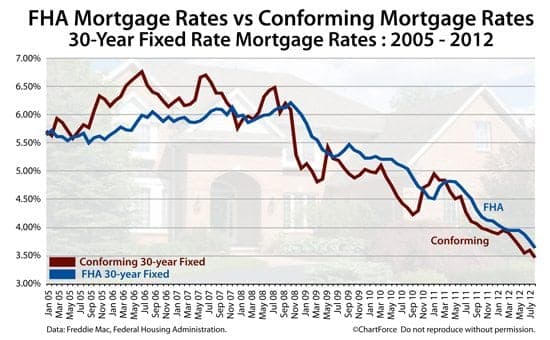
Comparing FHA mortgage rates to conventional mortgage rates 2009FHA mortgage rates are lower than conventional mortgage rates right now.

It's an interesting development, especially for homeowners and home buyers with low equity.

Unless you've got 20 percent into a property, if you're locking a 30-year fixed rate mortgage, there's compelling reasons to go FHA.

The first reason to choose FHA is an obvious one -- mortgage rates are lower. Right now, there's 1/8 percent difference between the comparable FHA and conventional 30-year fixed products and, over 30 years on a mortgage, that can really add up.

The second reason why FHA may be better than conventional right now is that FHA mortgage insurance premiums are lower versus the private insurance offered through Fannie or Freddie.

On a 10-percent-down home loan for applicants with A-plus credentials, FHA insurance ends up being cheaper by 0.34% per year.

Assuming a $200,000 mortgage, that's $680 per year and for people with FICOs under 740, the savings get substantially bigger. Find out your credit score for free from CreditReport.com if you don't know it already.

Despite these two reasons, however, when it comes to mortgages, we have to remember that it's not always about rate.  Costs matter, too.  FHA mortgages may be cheaper than conventional loans on an on-going basis, but they're rarely cheaper at the outset.

This is because FHA mortgage carry mandatory, up-front closing costs.  On streamline refis, the fee is 1.5 percent FHA fee; on purchase and regular refis, it's 1.75 percent; on "delinquent" mortgages, it's 3.0 percent.

Homeowners torn between FHA and conventional may find FHA "rate-attractive" but cost-prohibitive.  The math will vary from home-to-home, and homeowner-to-homeowner. Given the FHA's low rates, however, the program at least warrants some consideration.

To see how the math compares on your home, or pending home purchase, call or with the details of your situation. We'll see how the math works out best for you.


Dan Green is an active loan officer. Email or call 513-443-2020. Dan is on Twitter at @mortgagereports.

Tags: FHA mortgage rates, FICO, MIP, PMI

Comparing FHA And Conventional Mortgages With Less Than 20% Downpayment

Posted on October 20, 2009
Filed under FHA Mortgages
Read the complete post

PMI Defaults 2007-2009Private Mortgage Insurance is an insurance policy that is paid by homeowners for the benefit of lenders.

It's required for all conventional-mortgage homeowners whose loans exceed 80% loan-to-value.

Similar to homeowners insurance, private mortgage insurance gets "cashed in" when a loss occurs. In the case of the former, the loss may be storm damage; the latter, mortgage default.

With foreclosures proliferating, PMI defaults are up 26 percent over last year and double the levels from 2007.  Private mortgage insurers are paying out on many more claims than was expected and, as a result, are booking huge losses.

Homeowners are about to pay the price. To shore up balance sheets and protect against future losses, mortgage insurers have raised insurance rates and toughened underwriting guidelines.

Some of the changes we're seeing include:

  • Minimum FICO requirements of 720 based on loan-t0-value
  • Maximum debt-to-income ratios of 41%, regardless of Fannie Mae approval
  • Loan size limitations, based on the health of the local real estate market

And, of course, insurance premiums are increasing for everyone.

It's a 2-pronged attack that will make a less-than-20%-downpayment more costly for Fannie Mae- and Freddie Mac-backed mortgage.

The alternative is to look to the FHA for a mortgage.  There's 2 advantages here.

First, as compared to PMI rates, FHA mortgage insurance looks cheap.  A $200,000 FHA home loan with 10% down can save as much as $400 in insurance costs.  With 5% down, that number grows to $1,040 per year.

Second, with FHA mortgage rates running neck-and-neck with conventional ones, there's a lot of days when 30-year fixed mortgage rates are cheaper in the FHA market versus the conventional one.

The downside of FHA is that the government puts up to 1.750 percent insurance fee into your loan at the time of closing.  It's a cost that doesn't exist in the conventional world and, for some people, the fee makes FHA an imperfect fit.

The key is to talk with your loan officer about Conventional and FHA mortgages to make sure you're making the right choice.

For help with your FHA vs Conventional decision, anytime with the details of your situation.  I answer all of my own emails and am happy to help you with what I know.

Plus, my rates are really good.


Dan Green is an active loan officer. Email or call 513-443-2020. Dan is on Twitter at @mortgagereports.

Tags: FHA, MIP, Mortgage Insurance, PMI

Live Rate Quotes

Required fields are marked with *