If you want to be notified when I write something new on The Mortgage Reports, sign up for free daily email alerts or subscribe to the free RSS feed.

Why You Won’t Always Get The Lowest Advertised Mortgage Rates

Posted on January 11, 2010
Filed under Fannie Mae and Freddie Mac
Read the complete post

Thanks for visiting The Mortgage Reports. To stay absolutely current on mortgage markets and important guideline changes, be sure to take my free daily email alerts.

Loan-Level Pricing Adjustments in pictures

Mortgage rates are low but maybe not for you, specifically.

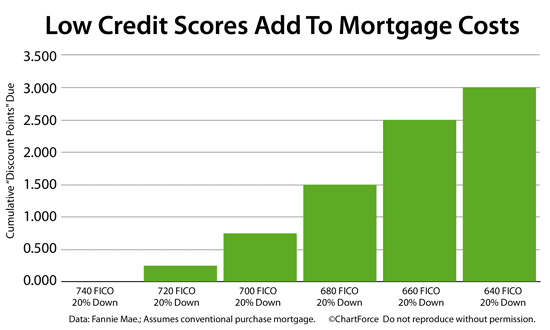
If you've ever wondered why loan officers can't give you the best "advertised rate", it's not because of a bait-and-switch scheme or something worse.  Most likely, you're being quoted higher mortgage rates because of a government mandate called Loan-Level Pricing Adjustments.

LLPAs are changes in loan costs based on your personal risk traits.

Fannie Mae and Freddie Mac first introduced loan-level pricing adjustments in April 2008 and they've been a constant cause of consternation among conforming borrowers since.

The problem is loan-level pricing adjustments aren't exactly Prime Time news and so the first time most people hear about them is at the point of application. LLPAs can raise a person's mortgage rate by a full percentage point or more.

To understand what LLPAs are and how they work, let's talk about auto insurance.

For all of us, there is some base insurance rate for which we all qualify.  It's based on our age, our credit and the ZIP code in which we park the car.  From there, however, adjustments are made -- drive a riskier car, pay a higher premium.  Have a history of accidents, pay a higher premium. Things like that.

The same goes for mortgage loans. The more the risk, the higher the rate.

A few of the risk factors that can change a person's mortgage rate include:

  • Living in a condo with less than 25% equity in the home
  • Having a credit score of less than 740
  • Living in a 2-unit, 3-unit or 4-unit home
  • Using a home as an investment property
  • Doing a "cash out" refinance with less than 40% equity in the home
  • Having a second mortgage to subordinate

Each of these traits -- historically -- increases the likelihood of your default.    Therefore, to hedge, Fannie Mae and Freddie Mac charge flat fees to offset potential future losses.

LLPAs are not discretionary fees; sources of profit or padding.  Nor are they junk fees.  LLPAs are mandatory costs triggered by specific loan characteristics.  There's no flexibility, either.  If you trigger the guidelines, you pay the fees.

The Fannie Mae Loan-Level Pricing Adjustment chart is as thorough as it is punitive. At least borrowers get to choose how they pay them:

  1. LLPAs can be paid as a traditional "closing cost", due at closing.
  2. LLPAs can be built into an interest rate. In general, interest rates increase 0.250% for each 1 percent of loan-level pricing adjustment.

It doesn't take much to trigger the risk-based pricing of Fannie Mae and Freddie Mac; a lot of conforming mortgage applicants do it.

If you've triggered the LLPA chart and want to know your options, call or . Depending on your loan traits, there may be non-government programs that can give the same great rates as Fannie and Freddie, but without the risk fees.

Be sure to ask me about it.  I answer all my own emails and would be happy to help you however I can.


Dan Green is an active loan officer. Email or call 513-443-2020. Dan is on Twitter at @mortgagereports.

Tags: Fannie Mae, Freddie Mac, LLPA, Ross Sisters, Swingers

SEO Copywriting Made Simple
I use Scribe to improve my blog SEO

Fannie Mae To Get Tougher On Mortgage Insurance, Income Levels and Credit Scores

Posted on September 29, 2009
Filed under Fannie Mae and Freddie Mac
Read the complete post

Fannie Mae Updates for DU Version 8.0For the second time in 10 weeks, Fannie Mae is toughening its mortgage guidelines again.  Again.

According to an internal Fannie Mae document, a review of the group's current "risk appetite, eligibility requirements, mortgage insurance options, and pricing" spawned changes spanning credit scoring, income requirements, loan-level pricing adjustments.

The Fannie Mae guideline changes are summarized, in part, below:

  • Minimum credit score requirement raised to 620
  • Total debt-to-income levels may not exceed 45 percent, except by exception
  • Loan-level pricing adjustments for loans with "minimum" PMI coverage

It's the loan-level pricing adjustment part that's most interesting.

Loan-level pricing adjustments are specific fees assessed for specific risks. Based on the current lender guidelines, if your credit score is low, you'll pay an extra fee to Fannie for your mortgage; if you're doing a cash-out refinance, you'll pay an extra fee to Fannie for your mortgage; if you live in a condo and have little equity, you'll pay an extra fee to Fannie for your mortgage.

LLPAs were first introduced in April 2008. Fannie Mae has upped them nine times since.

There's lot of ways to trigger the fees.

If the concept of risk-based fees seems weird, think of LLPAs like auto insurance. Base rates are the same based on product, but the driver of a sports car will pay for insurance versus, say, the driver of a minivan.  Higher risk to the insurer means higher premiums to the owner.

Mortgages work the same way.

At least with its latest LLPA revision, Fannie Mae gets a tiny bit democratic.  It gives its mortgage-insurance carrying homeowners a choice.

  1. Pay for higher levels insurance coverage month-after-month, or
  2. Pay for the "old" insurance coverage plus a one-time fee, due at  closing

For every borrower, there is a clear-cut, cost-effective solution but, regardless, in both cases, the costs to finance through Fannie Mae are going to be higher.

Fannie Mae set December 11, 2009 as its "effective date" for the changes.  All mortgage approvals after that date will be subject to the new minimum FICOs, expense ratios, and LLPAs.

Better to get a good rate today than to be ineligible for a great rate tomorrow.  If I can help you plan for an upcoming mortgage, call .


Dan Green is an active loan officer. Email or call 513-443-2020. Dan is on Twitter at @mortgagereports.

Tags: Back to the Future Theme Song, Cornelius, Ferris Bueller, LLPA, Mortgage Guidelines

The Federal Reserve Does Not Make Make Mortgage Rates (And Here’s Your Proof)

Posted on September 22, 2009
Filed under Fed Funds Rate
Read the complete post

Comparing the Fed Funds Rate to the 30-Year Fixed Mortgage Rate since 2000

If the Fed Funds Rate correlated to 30-year fixed mortgage rates, this chart would be linear. It's not.

This point takes on added significance 8 times annually when the Federal Open Market Committee meets.  The FOMC is the policy-setting ARM of the Federal Reserve.  It raises or lowers the Fed Funds Rate to slow down or speed up the economy, respectively.

The Fed's actions are so important to markets and investors that news organizations like the Wall Street Journal dedicate entire sections to things like "Fed Watching". Comprehensive coverage doesn't make the Fed Funds Rate any less misunderstood, however.

Even the brightest of the bright mistake the role of the FOMC in mortgage markets.

The Federal Reserve does not set mortgage rates. Mortgage rates are based on the raw price of mortgage-backed securities plus applicable loan-level pricing adjustments.  Or, with respect to jumbo mortgages, rates get set by individual banks.

The Fed does, however, influence rates.

Combining rhetoric with more than a trillion dollars, the Fed has helped keep fixed-rate conventional mortgages below 5.500% for the better part of the year.  And now markets are curious: Is the Fed done with its interventions?

The FOMC starts a 2-day meeting today and there's a 1 in a million chance the Fed will raise the Fed Funds Rate from its current range near 0.000 percent.  But that doesn't mean that mortgage rates won't change.  All that has to happen is for the Fed to change it rhetoric.

After its last meeting, the FOMC said the economy is "leveling off". Since then, the housing market has shown tremendous strength and Chairman Ben Bernanke has said the recession "is very likely over".  Therefore, it wouldn't be out of the question for the Fed to get more rosy in its economic outlook and that would cause mortgage rates to rise.

In fact, markets are almost prepping for it.

Today, rates are rising in advance of the FOMC's 2:15 PM ET press release Wednesday.  If you're the nervous type, consider locking in your mortgage rate.  There's a much bigger chance that rates will rise this week than rates will fall.

As a loan officer, I have a direct feed to the mortgage-backed securities market and watch it all day long.  I can help you time the market bottoms to get the best rates possible.  with your loan details and I can watch your rates for you.

Or, fan me up on Facebook -- I post semi-regular market updates to my profile.

Markets move quickly and unless you're watching the data in real-time, you're probably going to pay a higher rate than you have to.  Locking near-bottom requires precision.


Dan Green is an active loan officer. Email or call 513-443-2020. Dan is on Twitter at @mortgagereports.

Tags: Dumb and Dumber, Fed Funds Rate, FOMC, LLPA

How We Know That Existing Homes Sales Will Boom Through Summer 2009

Posted on June 3, 2009
Filed under Real Estate Sales
Read the complete post

Home Affordability Index April 2009

Each month, a real estate trade group publishes the Home Affordability Index, a measurement that accounts for home values, interest rates and family incomes to determine whether housing is getting more -- or less -- affordable for average Americans.

The Home Affordability Index a flawed report for a number of reasons.  For example, the index makes the 3 broad assumptions of:

  1. A national median home value despite its complete irrelevance as a metric
  2. An average mortgage rate that ignores state rate changes and LLPA differences
  3. A national median income that doesn't account for Cost of Living differences

In addition, the index is easily influenced by mortgage rates.

If we account for the 0.75% increase to rates over the last 5 days, the Home Affordability Index falls by 10 points to its lowest levels since December 2008.

Each of these issues undermine the Home Affordability Index's significance to housing.  However, we can't ignore the report entirely because it's a relative finding, measuring change in costs from month-to-month.  As home values have fallen and mortgage rates have, too, both the up-front and on-going costs of homeownership have dropped.  This realization is converting a bevy of long-term renters into first-time homeowners. 

It's also fueling a boom in home sales.

In April, the number of MLS-listed homes that went under contract rose by an astounding 7  percent.  It's the biggest one month jump in Pending Home Sales since October 2001, not coincidentally, the second-to-last month of the Early 2000s Recession.

Now, not every home under contract will make it to the closing table.  It's estimated that only 80 percent of them do.  But with so many potentially sold homes , you can't help but think that the economy is going to get a nice kick in the kiester sometime mid-summer. 

See, when "pending homes" become "sold homes",  things start to happen. 

Moving supplies get ordered; new furniture and appliances get bought; painters and landscapers get hired.  Money gets spent and the economy moves forward.  This is a well-known chain reaction and it's one reason why economists say the economy can't improve until housing improves -- home buyers spend too much money to have it otherwise. 

Traders agree.  The Materials and Consumer Staples sectors were the top two performers on Wall Street Tuesday.

Pending Home Sales are rising and it's a signal of strength.  From the data, we can infer that the number of active homebuyers is higher than in months prior and that will, eventually, create pressure on home prices to rise.  It hasn't happened yet, but when the demand for homes does finally exceed the supply, home values should turnaround in whichever neighborhoods the imbalance occurs.

Meanwhile, so long as mortgage rates remain below 6 percent while the government incents first-time home buyers, that turnaround could happen sooner rather than later.


Dan Green is an active loan officer. Email or call 513-443-2020. Dan is on Twitter at @mortgagereports.

Tags: Brewsters Millions, Home Affordability Index, LLPA, Pending Home Sales, Very Tasteful

Federal Reserve Member Bank Survey Results : Is It Easier, Or Harder, To Get A Prime Mortgage Versus Last Quarter?

Posted on May 26, 2009
Filed under Conforming Mortgage Guidelines
Read the complete post

The Federal Reserve Bank Senior Loan Officer Survey May 2009For homeowners and home buyers in search of "prime" mortgages, a Federal Reserve-led survey confirms what most mortgage applicants have found out the hard way -- getting approved for a home loan is tougher than ever before.

Each quarter, in a survey of its member banks, the Federal Reserve asks senior loan officers whether their respective prime residential mortgage guidelines have tightened over the 3 months prior. 

May's survey showed that half of all banks had tightened.

The report is more State of the Union than news, per se, but it's still worth studying because "prime mortgages" are historically reserved for applicants of "AAA" credit quality.  They have:

  1. The highest credit scores
  2. The highest income versus debt
  3. The highest home equity percentages

As the three legs of the Mortgage Approval Triangle, it's these elements that separate approvals from denials and, over the last 6 quarters, what were once barriers to approval have since morphed into hurdles.  To get the lowest mortgage rates available in today's market, a homeowner should come to the table with a 740 credit score, debt ratios under 45 percent, and a 60% loan-to-value or better

Without these qualifiers, you can still get good rates for a conforming loan, just not as good as the next guy. 

As part of the guideline tightening, there's now something called Loan-Level Pricing Adjustments on most prime loans.  It's a risk-based fee that works a lot like auto insurance -- the higher your risk to the lender, the higher your interest rate.  Low credit scores and high loan-to-values are the equivalent of driving a sportscar.

780 FICO with 50% LTV is a minivan.

This new system of scoring mortgage rates confounds homeowners everywhere whose all-time payment history is 100% perfect and who always borrow responsibily.  They wonder why they can't get access to the lowest mortgage rates available.  I know this because they email me about it.  The answer is tied to FICO and home equity.

And it's not just doctors, lawyers, and athletes asking, either -- it's everybody.

Meanwhile, banks getting tighter on guidelines has impacted "non-prime" borrowers, too, including homeowners with jumbo mortgages.  Because their loan sizes are too big for the "prime" market, these homeowners create additional balance sheet risks for banks that choose lend to them.  It's no surprise, therefore, that barey a quarter of the banks making "non-prime" loosened guidelines from February through April.

And wouldn't you know it -- jumbo mortgage rates are coming down, just fewer people qualify for them. You can  with your specific jumbo eligibility questions anytime.

The guideline news isn't all bleak, however.  Looking at the chart, it's apparent that banks are tightening their guidelines at a slower pace. 

Indeed, even 15 percent of the banks surveyed reported a modest loosening.  Patterns like this can be good for housing for two reasons:

  1. More qualified applicants creates a larger home buyer pool
  2. Refinancing boosts household cash flow, spurring spending and the economy

It's widely believed that credit tightening depeened the current recession.  A credit loosening, therefore, may help lead us out.  The Fed's survey doesn't show evidence of easing just yet, but later this year, we could see marked improvement.

Hopefully for home buyers and homeowners, when we do see that improvement, may mortgage rates be low enough to exploit it.


Dan Green is an active loan officer. Email or call 513-443-2020. Dan is on Twitter at @mortgagereports.

Tags: Federal Reserve Survey, LLPA, Mortgage Approval Triangle, Sage Rosenfels

FHA Ends Its 95 Percent Cash-Out Refinances March 31, 2009. 85 Percent Is New Maximum.

Posted on March 25, 2009
Filed under FHA Mortgages
Read the complete post

FHA Cash Out Refinance restrictions starting April 1 2009This isn't a new story, but more of a reminder. 

The FHA is discontinuing its 95% cash-out refinance program effective April 1, 2009. For all case assigmements made on or after April 1, 2009, cash-out refinances are limited to 85%.  "Case assignment" is FHA-speak for "registered loans".

It's a move that shouldn't surprise you.  As Fannie Mae and Freddie Mac have tightened their respective underwriting guidelines and added onerous loan-level pricing adjustments, the FHA has become the lender of last resort for a lot of Americans.

  • Is your credit score under 680? Think FHA.
  • Is your downpayment less than 10%? Think FHA.
  • Are you trying to take cash out from your home?  Think FHA.

See, over the last 18 months, Fannie and Freddie have repeatedly narrowed their respective strike zones.  That's bad news for people in want of a mortgage because Fannie and Freddie are often the source of the lowest-cost mortgages. After opening the lending door for everyone and his mother, both groups pulled back guidelines to a point where if you're not considered an excellent risk, they don't want you.

Now, FHA is getting tighter, too.  In limiting FHA cash-out refinances to 85% loan-to-value, it's also setting a few other rules:

  1. With less than 12 months since purchase, the home's appraised value cannot exceed its purchase price -- even if you've made home improvements.
  2. If you're delinquent on your home loan, you cannot do a cash-out refinance
  3. Co-signers can't be added to the mortgage note for purposes of qualifying

The FHA's moves are a defensive one.  As Fannie and Freddie turn away would-be borrowers, the FHA is insuring all of the "less-than-perfect" home loans.  Like in Coming To America, when Hakeem tells Lisa that his job is to clean up the trash, that's what the FHA has been doing. 

When you think of garbage, think of Akeem FHA!

The FHA's loan pool is disgusting right now.  Riddled with early-payment defaults, the FHA's portfolio quality is deteriorating and the powers-that-be have the difficult job of making loans available without making them too available.  My guess is that more tightening will be on the way throughout 2009 and 2010 and the government realizes that it's on the hook for a lot of bad loans.

Either way, you have to give the FHA credit.  At least they set deadlines and warn people about them.

If you have need to take a cash-out mortgage and the conforming lenders are telling you "no", look FHA and get your loan registered with a loan officer no later than Tuesday, March 31, 2009.  And be sure to check your local FHA loan limits, too -- they're different from your local conforming loan limits.


Dan Green is an active loan officer. Email or call 513-443-2020. Dan is on Twitter at @mortgagereports.

Tags: Coming To America, EPD, FHA, How I Met Your Mother, LLPA

The 3 States That Account For 50% Of The Nation’s Foreclosure Actions

Posted on March 13, 2009
Filed under Foreclosures
Read the complete post

Relative foreclosure rates by stateI like graphics. Graphics tell stories. Especially graphics like this one. 

According to RealtyTrac.com, California, Florida and Arizona -- home to just 19.99 percent of the country's populace -- accounted for half of the nation's foreclosure actions in February 2009.

This is especially interesting in the context of a USA Today graphic that gets granular on foreclosure down to the county level.  Turns out that when 2008 ended, 35 of the country's 3,232 counties were responsible for 50 percent of the year's foreclosure-related problems.

Foreclosure is a national issue, it's just not the kind of national issue that the press makes out to be. 

Sure, foreclosures exist and defaults do happen.  They're a more frequent occurrence than ever before.  But if you're living in Blue Ash, Ohio or La Grange, Illinois, you're not waking up to a street full of auction signs like some other folks.

But distance from the problem doesn't mean you're home free.  As loans go bad, mortgage lenders respond by tightening their guidelines; restricting what they'll lend and to whom.  It's one reason why downpayment requirements are higher and why loan-level pricing adjustments exist.

In this way, a local issue like mortgage default can be a problem to the nation as a whole.


Dan Green is an active loan officer. Email or call 513-443-2020. Dan is on Twitter at @mortgagereports.

Tags: LLPA, puns, RealtyTrac

New Fannie Mae Fees Just Around The Corner. Lock Your Mortgage Rate To Keep Your Closing Costs Down.

Posted on January 9, 2009
Filed under Fannie Mae and Freddie Mac
Read the complete post

Lock Alert : It's time to lock your mortgage rateIf you're shopping for a conforming mortgage right now, let me be crystal clear -- there's a near 100% probability that your mortgage rate and/or closing costs will be higher come this Monday, January 12. 

Fannie Mae's new fee structure is about to work its way through the system.

Read the detailed post on Fannie Mae's newest loan-level pricing adjustments and you'll see -- mortgage rates may be falling in Cincinnati and elsewhere, but if applying for a new home loan gets cost-prohibitive, it just doesn't matter

Remember, though, these changes are for Fannie Mae-bound mortgages only.  I bring up that distinction because they are plenty of loans that don't get sold to Fannie Mae and it's not always clear what those loan types are.  Non-Fannie Mae loans include:

  • "Jumbo" or "super jumbo" mortgages
  • FHA mortgages and VA mortgages
  • Niche-lender and portfolio loan products

And, as an exception to its rules, Fannie Mae is giving a free pass to people with 15-year terms or less.  Homeowners with a 15-year or 10-year fixed rate mortgage aren't subject to the new loan-level pricing adjustments.

The majority of rate shoppers, however, are looking longer than 15 years; they're looking at conforming-sized mortgages of the 30-year fixed rate variety. 

If that's you, stop looking and start locking. Call or when you're ready.


Dan Green is an active loan officer. Email or call 513-443-2020. Dan is on Twitter at @mortgagereports.

Tags: A Few Good Men, LLPA, Meatballs

Live Rate Quotes

Required fields are marked with *