If you want to be notified when I write something new on The Mortgage Reports, sign up for free daily email alerts or subscribe to the free RSS feed.

2010 Conforming Loan Limits : Same As 2009, 2008, 2007 and 2006

Posted on March 3, 2010
Filed under Conforming Loan Limits
Read the complete post

Thanks for visiting The Mortgage Reports. To stay absolutely current on mortgage markets and important guideline changes, be sure to take my free daily email alerts.

Conforming Loan Limits 2010

Conforming mortgages are appropriately named; they "conform" to the mortgage underwriting guidelines of Fannie Mae or Freddie Mac. Mortgages meeting these criteria are securitized on Wall Street as mortgage-backed bonds.

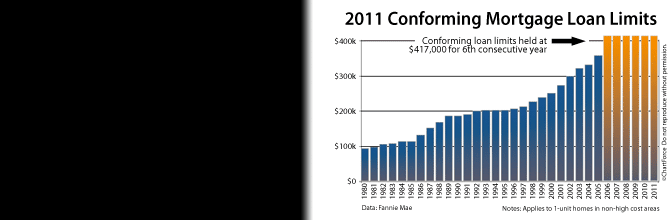
Since 2007, though, as mortgage performance has weakened, Fannie and Freddie's lending standards have tightened.  Today's would-be borrowers are asked to document more income, deeper reserves, and higher credit scores.  One underwriting area that hasn't tightened, however, is the maximum allowable loan size.

Conforming Loan Limits Vary By Property Type

For the 5th consecutive year, the 1-unit conforming mortgage loan limit is $417,000.

As released by the Federal Housing Finance Agency, the official 2010 conforming mortgage loan size limits are, by property type:

  • 1-unit properties : $417,000
  • 2-unit properties : $533,850
  • 3-unit properties : $645,300
  • 4-unit properties : $801,950

Note, however, that maximum conforming loan limits vary by market.

Conforming Loan Limits Vary By ZIP Code

Counties in which "typical" home prices dwarf the conforming loan limits are declared "high-cost" areas. Each gets its own, individual conforming loan limit that ranges up to $729,750.

For example, a home in Denver, Colorado is capped conforming at $417,000 but a home in Snowmass, Colorado gets clearance up to $729,750. Same for Mason, Ohio as compared to Athens, Ohio.

Mason's maximum loan size is $417,000; Athens' is $432,500.

Unfortunately, there's no breaks for residents of Chicago's tony neighborhoods -- Lake Forest, Lincoln Park, Hinsdale and elsewhere. Because each of the Chicagoland counties are a melange of housing types and socioeconomic class, none have sufficiently high median sales prices to justify the High-Cost Treatment.

According to the government, neither Lake County, Cook County, Dupage County, nor the collars count as high-cost.

What To Do If Your Mortgage Is "Jumbo"

Mortgages that exceed conforming loan limits are considered "jumbo" or "super jumbo". Excellent pricing is still available, you just have to know where to look.  And it's not at Fannie Mae.

There are just 197 designated high-cost areas in the U.S. -- 6% of the country. For the majority of homeowners, therefore, the 2010 conforming loan limit is $417,000.

To find your local market's loan limit and confirm it, check the Fannie Mae website.


Dan Green is an active loan officer. Email or call 513-443-2020. Dan is on Twitter at @mortgagereports.

Tags: Conforming Loan Limits, Fannie Mae, Freddie Mac, high-cost areas

SEO Copywriting Made Simple
I use Scribe to improve my blog SEO

2009 Conforming Loan Limits : Temporary Increases And Sub-Area Snubs

Posted on February 24, 2009
Filed under Conforming Mortgage Guidelines
Read the complete post

The OFHEO releases the 2009 conforming loan limits for all U.S. countiesThe government published its 2009 Conforming Loan Limit guidance Monday.

Listed by county, the report grants 324 parts of the country a temporary boost beyond the "normal" $417,000 Fannie Mae-bound mortgage loan limits. 

Designated "high-cost", these areas are differentiated by their local median sales price.  Temporary loan limits can range up to $729,750.

The complete "high-cost" area list is available for download.

Increasing conforming loan limits is part of the American Recovery and Reinvestment Act of 2009 and among the many ways that the government is providing economic stimulus. The change to $729,750 is meant to impact the economy two-fold:

  1. Stimulate demand for housing with abundant supplies of cheap money.
  2. Entice homeowners with existing jumbo and sub-prime mortgages to refinance into government-insured home loans, protecting banks and the private sector.

Considering that conforming mortgage rates are hovering near 5 percent, the change to make more homeowners eligible for Fannie Mae loans is step in the right direction.

However, all is not Peanut Butter Jelly Time.

In writing the law to extend conforming loan limits, Congress acknowledged that territories are rarely a uniform mix of high-cost -- or low-cost -- housing.  To compensate for intra-county discrepencies, therefore, it added specific language to the bill that grants the government power to designate "sub-areas" around the county to be "high-cost", even when their parent counties is specifically excluded.

As an example, sub-area status could apply to neighborhoods like Lincoln Park and Highland Park in Chicago, or Indian Hill in Cincinnati.  In these areas, homes are relatively pricey versus the whole of their respective counties.  And there are neighborhoods like this in every city, of course.

But what Congress didn't add to the stimulus bill was an explicit definition of the term "sub-area".

  • Is a sub-area defined by city limits? 
  • Is a sub-area defined by zip code?
  • Is a sub-area defined by census tract?

It's too bad sub-area was left undefined because that lack of defintion may be one reason why the government official empowered to grant High-Cost Treatment passed on that right, citing "implementation difficulties".  Furthermore, according to the press release, there are "no plans to use [that] discretion".

For now, all of Chicago and Cincinnati remain bound to $417,000.

Regardless, higher loan limits are a major plus for the nation.  With more homeowners qualifying for today's lower-cost conforming mortgages, two big positives emerge for the economy.

The first positive is that more Americans can buy and own their homes via government-backed funding.  This is especially important because, as second mortgage financing grows scarce(r), negating the need for HELOCs or HELOANs means more eligible applicants.  More buyers that can buy add additional buy-side demand for housing and that kind of demand is an essential ingredient in the housing recovery. 

The second positive is that more homeowners can participate in the ongoing Refi Boom.  With access to lower-cost mortgages and the ability to consolidate two liens into one, homeowners formerly relegated to Jumboland can reduce their mortgage rate, their monthly payment, and maybe even switch to a fixed-rate home loan from an ARM.

This, too, is important with respect to the economy because with smaller monthly payments, formerly-Jumbo homeowners can put additional dollars towards saving, spending, and investing.

The new loan limits apply to all mortgages originated in 2009.


Dan Green is an active loan officer. Email or call 513-443-2020. Dan is on Twitter at @mortgagereports.

Tags: high-cost areas, OFHEO, Peanut Butter Jelly Time

Live Rate Quotes

Required fields are marked with *