If you want to be notified when I write something new on The Mortgage Reports, sign up for free daily email alerts or subscribe to the free RSS feed.

2010 Conforming Loan Limits : Same As 2009, 2008, 2007 and 2006

Posted on March 3, 2010
Filed under Conforming Loan Limits
Read the complete post

Thanks for visiting The Mortgage Reports. To stay absolutely current on mortgage markets and important guideline changes, be sure to take my free daily email alerts.

Conforming Loan Limits 2010

Conforming mortgages are appropriately named; they "conform" to the mortgage underwriting guidelines of Fannie Mae or Freddie Mac. Mortgages meeting these criteria are securitized on Wall Street as mortgage-backed bonds.

Since 2007, though, as mortgage performance has weakened, Fannie and Freddie's lending standards have tightened.  Today's would-be borrowers are asked to document more income, deeper reserves, and higher credit scores.  One underwriting area that hasn't tightened, however, is the maximum allowable loan size.

Conforming Loan Limits Vary By Property Type

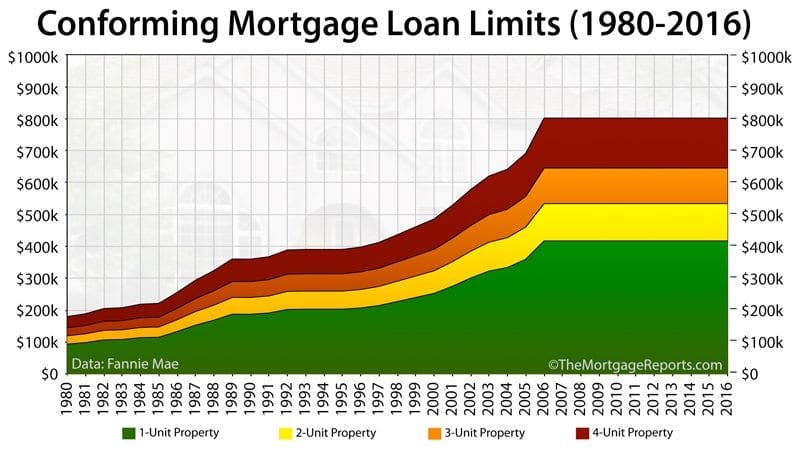
For the 5th consecutive year, the 1-unit conforming mortgage loan limit is $417,000.

As released by the Federal Housing Finance Agency, the official 2010 conforming mortgage loan size limits are, by property type:

  • 1-unit properties : $417,000
  • 2-unit properties : $533,850
  • 3-unit properties : $645,300
  • 4-unit properties : $801,950

Note, however, that maximum conforming loan limits vary by market.

Conforming Loan Limits Vary By ZIP Code

Counties in which "typical" home prices dwarf the conforming loan limits are declared "high-cost" areas. Each gets its own, individual conforming loan limit that ranges up to $729,750.

For example, a home in Denver, Colorado is capped conforming at $417,000 but a home in Snowmass, Colorado gets clearance up to $729,750. Same for Mason, Ohio as compared to Athens, Ohio.

Mason's maximum loan size is $417,000; Athens' is $432,500.

Unfortunately, there's no breaks for residents of Chicago's tony neighborhoods -- Lake Forest, Lincoln Park, Hinsdale and elsewhere. Because each of the Chicagoland counties are a melange of housing types and socioeconomic class, none have sufficiently high median sales prices to justify the High-Cost Treatment.

According to the government, neither Lake County, Cook County, Dupage County, nor the collars count as high-cost.

What To Do If Your Mortgage Is "Jumbo"

Mortgages that exceed conforming loan limits are considered "jumbo" or "super jumbo". Excellent pricing is still available, you just have to know where to look.  And it's not at Fannie Mae.

There are just 197 designated high-cost areas in the U.S. -- 6% of the country. For the majority of homeowners, therefore, the 2010 conforming loan limit is $417,000.

To find your local market's loan limit and confirm it, check the Fannie Mae website.


Dan Green is an active loan officer. Email or call 513-443-2020. Dan is on Twitter at @mortgagereports.

Tags: Conforming Loan Limits, Fannie Mae, Freddie Mac, high-cost areas

SEO Copywriting Made Simple
I use Scribe to improve my blog SEO

Mortgage Rates Change Faster Than Freddie Mac Can Report It

Posted on February 22, 2010
Filed under On Mortgage Rate Movement
Read the complete post

Freddie Mac PMMS survey is outdated before it's publishedPeople search for mortgage rates on Google.  That's not news.  They type in something like "Cincinnati mortgage rates" and then comb through the results in search of "today's rate".

Except Google doesn't give rates. Google gives links.

Links to random websites or elaborate sieves meant to capture eyeballs and generate applications.  The problem is, most people shopping for rates just want information -- they don't want to be sold something. Not yet, at least.

You can't window shop for mortgages on Google

You can't window shop Google for mortgage rates and it's frustrating.

This is because searching for a mortgage isn't like searching for a book.  You can't eliminate the information asymmetry inherent in mortgages; know the price before you step in the store, so to speak. You really can't know if you're getting the "guaranteed lowest rate".

In the mortgage markets, prices are elusive.

However, in doing the research, people learn a lot about mortgages.

Beyond that, though, it's an information abyss.

Freddie Mac's weekly survey is instantly out-of-date

When you're looking for mortgage rates, there's no crawler on Bloomberg; no ticker on Google Finance; no section in the newspaper.  Sooner or later, therefore, everyone trips into the Freddie Mac Primary Mortgage Market Survey.  It's one of the most widely-circulated mortgage rate surveys in the country.

Published since 1971, the Freddie Mac survey is the basis for national mortgage rate news, and for Home Affordability studies, and for congressional research, and about anything else mortgage-rate related.  The study is flawed in a big way, however. Huge.

The problem is in the survey's methodology.

According to Freddie Mac, Primary Mortgage Market Survey results are collected Monday through Wednesday, then published to the public Thursday. By design, therefore, the survey lumps mortgage market activity spread across 3 days into 1 single point of data.

Survey results are skewed, therefore, based on the when survey responders get back to Freddie Mac.

Last week, this point was painfully clear. Mortgage rates were down Tuesday morning, but rode the rocket higher Wednesday and Thursday.  It was the worst week for mortgage rates since late-December, actually.  And Freddie Mac missed it -- its survey was compiled before rates went bad.

So, Freddie Mac reported 30-year fixed mortgage rates down by 0.04% from the week prior.  Real mortgage pricing, however, showed rates up three-eighths.

A workaround : How to find actual mortgage rates online

What's a rate shopper to do? Well, for one, stop looking for rates on Google. Consider giving applications to a handful of loan officers and let them track your rates for you. A loan officer can (and will) tell you about your real-time pricing if you ask.

Next, add my Twitter feed to your "online research" library. If you've never been on Twitter, it's ridiculously easy and you can have my near-real-time updates pumped right to your mobile phone, if you'd like.

And, lastly, remember that mortgage rates change all day long. A quote issued in the morning won't be valid in the afternoon.  You have to stay on your toes if you want be ahead of market changes and lock the best possible rate.

In Cincinnati or anywhere else.

(Image adapted from Freddie Mac)


Dan Green is an active loan officer. Email or call 513-443-2020. Dan is on Twitter at @mortgagereports.

Tags: Freddie Mac, mortgage rates, Primary Mortgage Market Survey

Why You Won’t Always Get The Lowest Advertised Mortgage Rates

Posted on January 11, 2010
Filed under Fannie Mae and Freddie Mac
Read the complete post

Loan-Level Pricing Adjustments in pictures

Mortgage rates are low but maybe not for you, specifically.

If you've ever wondered why loan officers can't give you the best "advertised rate", it's not because of a bait-and-switch scheme or something worse.  Most likely, you're being quoted higher mortgage rates because of a government mandate called Loan-Level Pricing Adjustments.

LLPAs are changes in loan costs based on your personal risk traits.

Fannie Mae and Freddie Mac first introduced loan-level pricing adjustments in April 2008 and they've been a constant cause of consternation among conforming borrowers since.

The problem is loan-level pricing adjustments aren't exactly Prime Time news and so the first time most people hear about them is at the point of application. LLPAs can raise a person's mortgage rate by a full percentage point or more.

To understand what LLPAs are and how they work, let's talk about auto insurance.

For all of us, there is some base insurance rate for which we all qualify.  It's based on our age, our credit and the ZIP code in which we park the car.  From there, however, adjustments are made -- drive a riskier car, pay a higher premium.  Have a history of accidents, pay a higher premium. Things like that.

The same goes for mortgage loans. The more the risk, the higher the rate.

A few of the risk factors that can change a person's mortgage rate include:

  • Living in a condo with less than 25% equity in the home
  • Having a credit score of less than 740
  • Living in a 2-unit, 3-unit or 4-unit home
  • Using a home as an investment property
  • Doing a "cash out" refinance with less than 40% equity in the home
  • Having a second mortgage to subordinate

Each of these traits -- historically -- increases the likelihood of your default.    Therefore, to hedge, Fannie Mae and Freddie Mac charge flat fees to offset potential future losses.

LLPAs are not discretionary fees; sources of profit or padding.  Nor are they junk fees.  LLPAs are mandatory costs triggered by specific loan characteristics.  There's no flexibility, either.  If you trigger the guidelines, you pay the fees.

The Fannie Mae Loan-Level Pricing Adjustment chart is as thorough as it is punitive. At least borrowers get to choose how they pay them:

  1. LLPAs can be paid as a traditional "closing cost", due at closing.
  2. LLPAs can be built into an interest rate. In general, interest rates increase 0.250% for each 1 percent of loan-level pricing adjustment.

It doesn't take much to trigger the risk-based pricing of Fannie Mae and Freddie Mac; a lot of conforming mortgage applicants do it.

If you've triggered the LLPA chart and want to know your options, call or . Depending on your loan traits, there may be non-government programs that can give the same great rates as Fannie and Freddie, but without the risk fees.

Be sure to ask me about it.  I answer all my own emails and would be happy to help you however I can.


Dan Green is an active loan officer. Email or call 513-443-2020. Dan is on Twitter at @mortgagereports.

Tags: Fannie Mae, Freddie Mac, LLPA, Ross Sisters, Swingers

Trends: Mortgage Rates Fall In The Fall

Posted on October 14, 2009
Filed under On Mortgage Rate Movement
Read the complete post

Mortgage rate trends and cycles Jan 2006-Oct 2009

If history is an indicator, mortgage rates should ease a bit into 2010.

Data from Freddie Mac since 2006 shows that 30-year fixed mortgage rates tend to rise during the summer months, and fall through the fall.

So far, 2009 is staying true to form.

After a post-Memorial Day mortgage rate run-up, the 30-year fixed idled through June, July and August.  And then, on Labor Day, as if on cue, Cincinnati homeowners caught a break.  Mortgage rates began to drop.

By the first week in October, rates had returned to early-May levels, the damage of the summer unwound.

But for homeowners in want of a refinance, 2009 may not be the year to wait on lower-rates-to-come.  This year -- this year in particular -- is very different from the 3 years prior.  This year, the economy is emerging from recession as opposed to entering one.

Today's market environment is distinctly different from what we're used to.

  1. The Federal Reserve is ending its mortgage market support instead of beginning it
  2. Legitimate concerns about inflation are resurfacing on Wall Street
  3. World economies are showing signs of life, spurring global equity investment
  4. The U.S. Dollar is sagging against other currencies, devaluing mortgage bonds

Individually, these events exact a measurable, upward force on mortgage rates.  Together, they could completely wreck today's low-rate environment.

We could be looking at 7 percent mortgage rates in a flash, or rates could ease into the New Year.

Either outcome is plausible and that's why timing a market bottom is so challenging.

As a rate shopper, it's important to know what markets are doing at any given moment.  Unfortunately, there's no authorized source that gives the information for free.  Even the U.S. Treasury market fails as a proxy anymore.

So, to keep up with rates on your own, do it the free way -- follow my feed on Twitter or fan me on Facebook. I post near-real-time mortgage market updates several times daily and -- because I know how the banks play The Rate Game -- I post advance notice about when a rate change is about to happen.

Generally, I'm giving about 15 minutes notice.

You can also get a feel for what rates are doing right now by using the "Rate Offer" form at the top-right of this page. If your situation can't be summed up in 8 simple fields, .


Dan Green is an active loan officer. Email or call 513-443-2020. Dan is on Twitter at @mortgagereports.

Tags: Freddie Mac, Mortgage Rate Trends

Mortgage Rates Are Not As Low As Newspapers Are Reporting

Posted on October 13, 2009
Filed under On Mortgage Rate Movement
Read the complete post

Freddie Mac PMMS survey is outdated at the moment it is publishedThursday, Freddie Mac published its weekly mortgage market survey.

The report showed 30-year fixed mortgage rates sub-5 percent, near all-time lows.  Versus October 2008, they're down 1.07%.

The press was eager to report a story like this -- mostly because anytime mortgage rates below 5.000 percent, it makes for good copy.

But for rate shoppers in Cincinnati and Chicago, by the time Friday's business section was delivered, the Freddie Mac survey was woefully out-of-date.  Mortgage rates had already started to rise on a series of newsworthy notes:

  • Australia lifted its interest rates, the first major economy to make a move like that
  • Members of the Federal Reserve hinted that the Fed may raise rates soon
  • Concerns of inflation crept back into the Wall Street psyche

Combined, these elements led to a furious mortgage market sell-off so that by 4:00 PM ET Friday, mortgage rates were posting 3/8 higher than what Freddie Mac said they should be.

Rate shoppers get angry when stuff like that happens.  And, it seems to happen a lot.

Weekly surveys like the Freddie Mac report are good for watching long-term trends in mortgage rates, but they stink for when you need immediate "Lock or Float" advice. Remember, mortgage rates change every few hours so rate surveys are often "stale" before they're even published.

One easy (and free) way to track what's happening with mortgage rates is to fan my Facebook page and/or follow me on Twitter. I post markest updates several times per day and often alert before rates get worse.

From the time I advise to lock rates, you'll generally have less than 15 minutes to contact your lender and commit.  If you've already got a loan application on file, that's plenty of time to execute the trade.

If you don't have an application on file, though, or have trouble reaching your loan officer at a moment's notice, your chances of locking the rate drop dramatically.  It takes time to give an application, issue an approval, and position for locking.  It can take even more time for a lender to check his voicemails and return a call.

Mortgage rates wait for nobody.

I monitor and lock mortgage rates for my clients and do it with an automated system. If you're not getting the service you want or expect from your current lender, call or . I'll manage your rate lock for you and can probably save you some money in the process, too.


Dan Green is an active loan officer. Email or call 513-443-2020. Dan is on Twitter at @mortgagereports.

Tags: Freddie Mac, Inflation, mortgage rates

Trends : How Mortgage Rates Behave In The Fall

Posted on September 2, 2009
Filed under On Mortgage Rate Movement
Read the complete post

Mortgage rate trends and cycles 2006-2009

If recent history is an indicator, Labor Day should bring lower mortgage rates with it.

Data from Freddie Mac since 2006 shows that 30-year fixed mortgage rates tend to elevate through the warmer months of May, June, July and August before settling lower into the fall season. This year has stayed true to form.

After tacking on a half-percent post-Memorial Day, mortgage rates never quite recovered and sit near their highest levels of the year.  Rates look poised to dip, however.

  1. The U.S. dollar is strengthening internationally, boosting the appeal of dollar-denominated securities. This includes mortgage-backed bonds.
  2. The U.S. is showing signs of economic recovery and it's making the recovery without introducing inflationary pressures
  3. Equity sell-offs are pushing freed cash into the mortgage-backed bond market

All 3 forces combine to pressure mortgage rates lower -- even as the Federal Reserve winds down its $750 billion mortgage market intervention.

September 1, conventional mortgage rates fell by 1/8.

As a rate shopper, it's tough to know what's happening with mortgage rates in real-time because the CNBC ticker doesn't show MBS pricing like it does for the Dow Jones Industrial Average or for stocks.   Even the U.S. Treasury market fails as a proxy these days.

Mortgage pricing is a complex beast and, unfortunately, Wall Street's raw pricing is protected.

To keep up with rates on your own, follow my feed on Twitter.  I update with market movements several times daily and, because I know how the banks play The Rate Game, I like to signal when a mortgage rate change coming down the pike.  Generally, I'm giving about 30 minutes notice.


Dan Green is an active loan officer. Email or call 513-443-2020. Dan is on Twitter at @mortgagereports.

Tags: Freddie Mac, mortgage rates, Rerun Dance

Knowing When To Lock Or Float Is Easy When Mortgage Rates Are Range-Bound

Posted on July 24, 2009
Filed under On Mortgage Rate Movement
Read the complete post

Mortgage Rates Trends - December 2008 to July 2009

I recently described mortgage rates as being "range-bound", repeatedly returning to the same 5.250 percent, 0 points marker since last December.

Rather than take my word for it, though, check this chart. It plots the Freddie Mac 30-year fixed mortgage rate from December 2008 to July 2009.

Over the past 8 months, Freddie Mac's reported mortgage rates have carved out a wide range -- from 4.750 to 5.750 percent.

These aren't "true" mortgage rates, per se, because Freddie Mac reports its rates weekly and mortgage rates change multiple times daily. There have been days, for example, when rates moved higher or lower than what's plotted above.  Additionally, Freddie Mac reports rates as if of points were being paid.

To undo the "points", we'd have to increase the charted rates by about 0.2%.

And that brings us back to the initial point: No matter how many times rates go higher or go lower, they keep retracing back toward 5-and-a-quarter.

Also worth noting?  Mortgage rates have yet to come close to the fabled "4 percent" number that's people hang their hats on.  The lowest 0-point rates have we've seen since December is 4.500% and that lasted for less than an hour.

So, to sum up, if you still haven't refinanced your home to a lower rate, or moved from your adjustable-rate mortgage to a fixed rate one, use the chart as your guide.  Consider anything less than 5.250 percent is "good" because, if history is an indicator, rates are likely to pop right back.


Dan Green is an active loan officer. Email or call 513-443-2020. Dan is on Twitter at @mortgagereports.

Tags: Freddie Mac, mortgage rates

The Untimely Timing Of The Freddie Mac Primary Mortgage Market Survey

Posted on June 22, 2009
Filed under On Mortgage Rate Movement
Read the complete post

The Freddie Mac Primary Mortgage Market Survey is expired before it's publishedTo a consumer, one of the most difficult facets of shopping for a mortgage is figuring out just what mortgage rates are doing at any given time.

Despite countless websites and blogs devoted to the topic of mortgage, the most important part of a person's research -- the darn price -- can't be found hardly anywhere online.

It's a horrifying revelation for people vis-à-vis the way we've all been trained to use the internet.  After all, we're conditioned to use the internet as a means to eliminate information asymmetry; to know the price before we ever step foot in the store, so to speak.  That way, we can be sure we're negotiating the best possible deals for ourselves.

Except it doesn't work like that for mortgages.  Prices are elusive.

Through the course of doing mortgage-related research online, most people actually learn a lot about home loans.

  • They learn that mortgage rates are based on mortgage-backed bonds and not the 10-year Treasury Note
  • They learn the intricacies of how FHA Streamlines work and about MIP refunds
  • They learn how Conforming Loan Limits apply to their specific zip code

Beyond that, however, it's an information abyss.

When you want to know what mortgage rates are doing, there's no crawler you can watch on CNBC.  There's no ticker symbol to track on Google Finance.  There's not even a section on the Investor’s Business Daily website for it.  So, in the absence of timely mortgage rate information -- unfortunately -- people turn to whatever information they can find.

And that's when the trouble starts.

One of the most widely-recognized mortgage rate surveys is the Freddie Mac's Primary Mortgage Market Survey.  Published since 1971, it's the basis for national mortgage rate news stories, for Home Affordability studies, for congressional research, and about anything else mortgage-rate related.

The Freddie Mac survey gets a lot of ink in the nation's newspapers and, for most people, it's the only news they hear about whether mortgage rates are rising or falling.

The study is flawed in a big way, however.  Huge.  The problem is with the survey's methodology.

According to Freddie Mac, Primary Mortgage Market Survey results are collected from survey participants Monday through Wednesday, and then published to the public Thursday.  The survey is grouping mortgage rates into a static data point when, in fact, they're anything but static.

It's an egregious example, but across those 3 days last week, lenders issued 9 separate rate sheets with a 1/2 percent spread between them. Survey results were destined to be skewed depending on which day survey participants checked back with Freddie Mac.

Furthermore, because Freddie Mac embargoes the survey results until Thursday morning, there's even another day through which mortgage rates can change.

Again, looking at last week, markets sold off with force Thursday morning, causing rates to rise 0.375 percent before noon.  By the time the Freddie Mac survey was published, therefore, it had zero practical application to rate shoppers in Cincinnati or anywhere else.

The Freddie Mac Primary Mortgage Market Survey reported "average mortgage rates" well below what was actually available at the time its publication.

So, for active home buyers and people wanting to refinance, it's not tough to find information about mortgages, it's only tough to get information about mortgage rates.  Specifically, mortgage rates as they apply to your personal profile.

One solution is to watch my Twitter feed at http://twitter.com/mortgagereports.

If you've never been on Twitter, it's a low-impact workout.  Sign up for a free account, follow me (@mortgagereports), and then check back as often as you'd like.  Whenever you re-visit my Twitter page, you'll see the last series of updates and you can get a feel for whether rates are improving or worsening.  I update the feed several times per day -- more often when markets are turning quickly.

If after some time you find that my Twitter feed isn't "personal" enough for you, and ask to be on the Rate Watch list.  I'll reply back with a request for some basic information and we'll get a feel for today's interest rates as they apply to what you've got going on.  Then, if everything makes sense for you, we can put a Rate Lock agreement in place at your request so that when your target interest rate hits, we'll be ready to lock it on your behalf.

Mortgage rates move quickly and you can't wait for Freddie Mac to tell you what they are.  It's the most heavily-relied upon sources of mortgage rates and it's outdated before it's ever published.  Instead, consider relying on me.


Dan Green is an active loan officer. Email or call 513-443-2020. Dan is on Twitter at @mortgagereports.

Tags: Freddie Mac, PMMS, Pretty Woman, Tom Leppard

Live Rate Quotes

Required fields are marked with *