If you want to be notified when I write something new on The Mortgage Reports, sign up for free daily email alerts or subscribe to the free RSS feed.

Explaining The Federal Reserve’s Statement In English (March 16, 2010)

Posted on March 16, 2010
Filed under FOMC Announcements
Read the complete post

Thanks for visiting The Mortgage Reports. To stay absolutely current on mortgage markets and important guideline changes, be sure to take my free daily email alerts.

Putting the FOMC statement in plain EnglishToday, the Federal Open Market Committee voted 9-to-1 to leave the Fed Funds Rate unchanged, in its target range of 0.000-0.250 percent.

In its press release, the FOMC noted that the U.S. economy "has continued to strengthen" and that the jobs markets "is stabilizing".  It also said that business spending has "has risen significantly".

This is a slight departure from the Fed's January statement in which housing was not mentioned at all, and business spending was said to be "picking up".

The change is notable, even if barely detectable.

Today's statement also marks the 6th straight session after which the Fed described the economy with optimism.  The 2008-2009 recession is over and that growth is returning to Ohio and the U.S., in general.

The economy is not without threats, however, and the Fed identified several:

  1. High unemployment threatens consumer spending
  2. Housing starts are at a "depressed level"
  3. Consumer credit remains tight

The message’s overall tone, however, remained positive and inflation remains within tolerance limits.

Lastly, the Fed confirmed its plan to end its $1.25 trillion mortgage markets commitment in March 31, 2010. Fed insiders estimate that the bond-buying program lowered mortgage rates by 1 percent since its start. Rates should rise once the program expires.

Mortgage market reaction is muted to the Fed's press release. Mortgage rates are unchanged this afternoon.

The FOMC’s next scheduled meeting is a 2-day affair, April 27-28, 2010.

(Content supplied by Bring the Blog)


Dan Green is an active loan officer. Email or call 513-443-2020. Dan is on Twitter at @mortgagereports.

Tags: Fed Funds Rate, federal reserve, FOMC

SEO Copywriting Made Simple
I use Scribe to improve my blog SEO

Correlating Mortgage Rates To The Fed Funds Rate

Posted on March 16, 2010
Filed under Fed Funds Rate
Read the complete post

Fed Funds Rate vs 30-year fixed rate mortgage (1990-2010)

The Federal Open Market Committee meets today and will vote to keep the Fed Funds Rate unchanged. But don't rest on your rate-locking laurels.

Mortgage Rates Are Made On Wall Street

When the Federal Reserve votes to leave the Fed Funds Rate unchanged, it's different from the Fed keeping mortgage rates unchanged.  Actually, the Fed can't leave mortgage rates unchanged because its powers don't extend to the mortgage markets. Mortgage rates are "made" on Wall Street, in open trading.

The Fed Funds Rate is unrelated to mortgage rates.

Looking back 20 years, the difference between the two benchmark rates has been as wide as 5 points and as narrow as 1. And, prior to that, in 1973-74 and again in 1980-81, the spread went negative. 30-year fixed mortgage rates were actually less the Fed Funds Rate.

If the Fed Funds Rate directly related to mortgage rates, the spreads would be linear.

The Fed's Statement Will Make Rates Change

The Fed doesn't set mortgage rates and the markets will make that clear again this afternoon.  Despite the Fed announcing its intent to keep the Fed Funds Rate near zero "for an extended period of time", mortgage rates will dance.

If the Fed's press release carries a positive tone about the economy and economic growth, mortgage rates will rise.  If the tone is negative, rates will fall.

Today is not a good day to float your mortgage.

What To Do If Your Loan Isn't Locked Yet

If you're not locked in, talk to your loan officer in advance of the Fed's 2:15 P.M. ET announcement. Rates are more likely to rise than to fall.

Or, if you don't have a loan officer, with your details. I'm happy to get your rate locked right away -- before potential changes for the worse.


Dan Green is an active loan officer. Email or call 513-443-2020. Dan is on Twitter at @mortgagereports.

Tags: 30-Year Fixed Mortgage, Fed Funds Rate, federal reserve, FOMC

Watching How Mortgage Rates Moves As Compared To The Fed Funds Rate (1990-2010)

Posted on January 26, 2010
Filed under Fed Funds Rate
Read the complete post

Comparing the Fed Funds Rate to the 30-year fixed rate mortgage (1990-2010)

The Federal Reserve begins a scheduled 2-day meeting today during which it which it will vote to leave the Fed Funds Rate unchanged near zero percent.  The press will report this tomorrow as "Fed Holds Rates Steady".

But, don't confuse this to mean that the Fed held mortgage rates near zero. The Fed doesn't set mortgage rates.  The Fed sets the Fed Funds Rate. The former is a long-term rate and the latter is a short-term rate.

The Fed Funds Rate and the 30-year fixed mortgage are two different animals.

The Fed Funds Rate is set by the Federal Reserve to accelerate or retard economic growth.  Mortgage rates are set by price of mortgage-backed securities at any given moment plus any applicable loan-level pricing adjustments. If the two were directly related, the chart above would be linear.

Instead, it's got more steps than the cover of Houses of the Holy.

Since 1990, the spread between the Fed Funds Rate and the 30-year fixed rate mortgage has been as narrow as 1 percent and as wide as 5 percent.  Going back even further, to 1973-74 and then again to 1980-81, there's been instances of the interest rate spread going negative; mortgage rates were below the Fed Funds Rate.

Hopefully it's clear now. Mortgage rates and the Fed Funds Rate move independently. The Fed doesn't set mortgage rates.

However, it does influence them.

As the nation's central banker, the Federal Reserve sets policies that change the U.S. economy's direction and changes in the economic happen to make a huge impact on mortgage rates.  It's one reason why mortgage rates were so volatile in 2009 -- the future of the economy was a giant glob of murk and as Wall Street did its bidding, rate shoppers got tossed along for the ride.

So, let's ignore what the Fed will or won't do tomorrow and focus instead on what the Fed says.

See, when the Fed adjourns, it issues a statement in which Bernanke & Co address the nation's economic strengths, weaknesses and threats. If the Fed's statement shows optimism for the economy in its statement, mortgage rates will rise as money flows away from the safety of the mortgage-bond market.

If the Fed's statement show pessimism, on the other hand, mortgage rates will fall.

Either way, be on alert.  The Fed statement hits at 2:15 PM ET Wednesday.

For Cincinnati home buyers and homeowners shopping for low mortgage rates, you must understand the difference between the Fed Funds Rate and a long-term mortgage rate. When you do, you're more likely to lock a mortgage rate on time as opposed to locking a mortgage rate too late.

If you've never been on the wrong side of that gamble, just ask a friend -- it stinks.

So, to get help with your rate lock, including timing it for the lowest possible rates in your local market, with your details and I'll do my best to help get you started. I answer all my own emails and my mortgage rates are very good.


Dan Green is an active loan officer. Email or call 513-443-2020. Dan is on Twitter at @mortgagereports.

Tags: Fed Funds Rate, FOMC, Mortgage Myths, WWF

How The Fed’s Official Statement Today Could Move Mortgage Rates In April By 1 Percent Or More

Posted on December 16, 2009
Filed under FOMC Announcements
Read the complete post


Dan Green is an active loan officer. Email or call 513-443-2020. Dan is on Twitter at @mortgagereports.

Tags: Fed Funds Rate, FOMC, Inflation

5 Things That Don’t Control Mortgage Rates

Posted on October 7, 2009
Filed under On Mortgage Rate Movement
Read the complete post

Mortgage rates are controlled by the price of mortgage-backed bondsThis is a short list of things that don't control mortgage rates:

1. 10-Year Treasury Note

Over long periods, the 10-year treasury trends with mortgage-backed securities. On any given day, however, the two can move in opposite directions. You can't watch the 10-year ticker on TV and think you know where mortgage rates are going.

2. The Fed Funds Rate

The Fed Funds Rate is the rate at which banks borrow from each other overnight. A mortgage rate, by contrast, is the rate at which a homeowner borrows from a lender. If the Fed Funds Rate and mortgage rates were connected, this chart wouldn't be so jagged.

3. Ben Bernanke

Ben Bernanke is the Chairman of the Federal Reserve, the group that sets the Fed Funds Rate. His influence on mortgage rates, therefore, is muted. However, Bernanke's Fed has been a buyer of mortgage bonds in 2009 so its influence on rates is somewhat elevated. The buying schedule ends in March 2010.

4. Congress

Congress can sway mortgage markets with policies and rhetoric, but as the legislative branch of the U.S. government, its influence on mortgage rates remains indirect. No matter what it says or does to influence the economy, it's still the traders in the mortgage markets that have to take the bait.

5. Chuck Norris

Although Chuck Norris can beat a brick wall in a game of tennis, his legend is no match for mortgage rates. When markets decide they want to rise, they rise.


There's only one thing that controls mortgage rates -- the price of mortgage-backed bonds. Unfortunately, there's no publicly-available tool to watch how mortgage-backed bonds are changing on an hour-to-hour basis.

As a loan officer, I pay for a premium data feed to track mortgage-backed bonds in real-time. I post semi-regular updates to my Facebook Fan page and to Twitter.

For some people, though, that's not personal enough and I understand.

If I can ever help with your individual rate lock decision or to act as a sounding board for your mortgage ideas, . I answer my emails personally and am happy to help you with strategy.


Dan Green is an active loan officer. Email or call 513-443-2020. Dan is on Twitter at @mortgagereports.

Tags: Ben Bernanke, Chuck Norris, Fed Funds Rate, Mortgage-Backed Securities

How Today’s FOMC Statement Affects Mortgage Rates And Homeowners (September 23, 2009)

Posted on September 23, 2009
Filed under Federal Open Market Committee (FOMC)
Read the complete post


Dan Green is an active loan officer. Email or call 513-443-2020. Dan is on Twitter at @mortgagereports.

Tags: Fed Funds Rate, FOMC, YouTube

The Federal Reserve Does Not Make Make Mortgage Rates (And Here’s Your Proof)

Posted on September 22, 2009
Filed under Fed Funds Rate
Read the complete post

Comparing the Fed Funds Rate to the 30-Year Fixed Mortgage Rate since 2000

If the Fed Funds Rate correlated to 30-year fixed mortgage rates, this chart would be linear. It's not.

This point takes on added significance 8 times annually when the Federal Open Market Committee meets.  The FOMC is the policy-setting ARM of the Federal Reserve.  It raises or lowers the Fed Funds Rate to slow down or speed up the economy, respectively.

The Fed's actions are so important to markets and investors that news organizations like the Wall Street Journal dedicate entire sections to things like "Fed Watching". Comprehensive coverage doesn't make the Fed Funds Rate any less misunderstood, however.

Even the brightest of the bright mistake the role of the FOMC in mortgage markets.

The Federal Reserve does not set mortgage rates. Mortgage rates are based on the raw price of mortgage-backed securities plus applicable loan-level pricing adjustments.  Or, with respect to jumbo mortgages, rates get set by individual banks.

The Fed does, however, influence rates.

Combining rhetoric with more than a trillion dollars, the Fed has helped keep fixed-rate conventional mortgages below 5.500% for the better part of the year.  And now markets are curious: Is the Fed done with its interventions?

The FOMC starts a 2-day meeting today and there's a 1 in a million chance the Fed will raise the Fed Funds Rate from its current range near 0.000 percent.  But that doesn't mean that mortgage rates won't change.  All that has to happen is for the Fed to change it rhetoric.

After its last meeting, the FOMC said the economy is "leveling off". Since then, the housing market has shown tremendous strength and Chairman Ben Bernanke has said the recession "is very likely over".  Therefore, it wouldn't be out of the question for the Fed to get more rosy in its economic outlook and that would cause mortgage rates to rise.

In fact, markets are almost prepping for it.

Today, rates are rising in advance of the FOMC's 2:15 PM ET press release Wednesday.  If you're the nervous type, consider locking in your mortgage rate.  There's a much bigger chance that rates will rise this week than rates will fall.

As a loan officer, I have a direct feed to the mortgage-backed securities market and watch it all day long.  I can help you time the market bottoms to get the best rates possible.  with your loan details and I can watch your rates for you.

Or, fan me up on Facebook -- I post semi-regular market updates to my profile.

Markets move quickly and unless you're watching the data in real-time, you're probably going to pay a higher rate than you have to.  Locking near-bottom requires precision.


Dan Green is an active loan officer. Email or call 513-443-2020. Dan is on Twitter at @mortgagereports.

Tags: Dumb and Dumber, Fed Funds Rate, FOMC, LLPA

Chart : Comparing The Fed Funds Rate To 30-Year Fixed Mortgage Rates

Posted on June 29, 2009
Filed under Fed Funds Rate
Read the complete post

Comparing the Fed Funds Rate to the Freddie Mac 30-Year Fixed Mortgage Rate Since 2000

Adjectives play an important role in the English language.  They modify nouns.  Because of adjectives, we can linguistically separate good movies from bad movies, rainy days from sunny days, and sore losers from lovable losers.

Sometimes, adjectives can be superfluous.  For example, this is a mortgage blog. When I write "rates are lower", it's implied that I'm talking about mortgage rates.

In some cases, though, omitting adjectives can lead to dangerous misunderstandings.  One of the most common examples in the Mortgage World recurs each time the Federal Open Market Committee adjourns.

The FOMC meets at least eight times annually and, at each meeting, the Fed votes to raise, lower, or leave unchanged the Fed Funds Rate.  The vote has huge implications for the U.S. economy and often makes worldwide news.

Unfortunately,  when reporting on the FOMC's decision, press members often fail to include the leading adjective.  They'll say something like, "The Fed voted to raise rates today" instead of "The Fed voted to raise the Fed Funds target rate today".

It's an important distinction because most Americans never learned about the scope of the Federal Reserve's control; they don't know how the Fed influences banking.

Furthermore, because Americans tend to believe that the Federal Reserve controls mortgage rates, when people hear that "rates were raised", they assume it to mean that mortgage rates were raised, too.

Mortgage rates and the Fed Funds Rate don't move in tandem.  The chart proves it.

Since 2000, the spread between the Fed Funds Rate and the 30-year fixed rate mortgage has been as narrow as 1 percent and as wide as 5 percent -- hardly a direct relationship.  There was even a period in the 1970s and 1980s where the spread was negative; where mortgage rates were lower than the Fed Funds Rate.

One reason why the two rates move semi-independently is that the Fed Funds Rate is an overnight rate and the 30-year fixed rate is a long-term rate.  Borrowing and lending is much less risky over an 8-hour period versus a 263,000-hour period.

Last week, the Federal Open Market Committee voted to hold its benchmark lending target rate between 0.000 percent and 0.250 percent.  Mortgage rates fell on the news.


Dan Green is an active loan officer. Email or call 513-443-2020. Dan is on Twitter at @mortgagereports.

Tags: Family Guy, Fed Funds Rate, Sesame Street, The Curious Case of Benjamin Button

What Is The Federal Open Market Committee And How Does It Change Mortgage Rates?

Posted on April 29, 2009
Filed under FOMC
Read the complete post

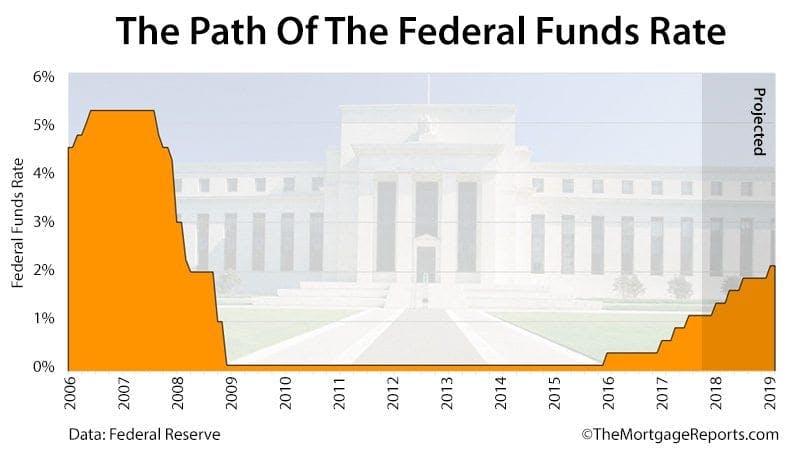
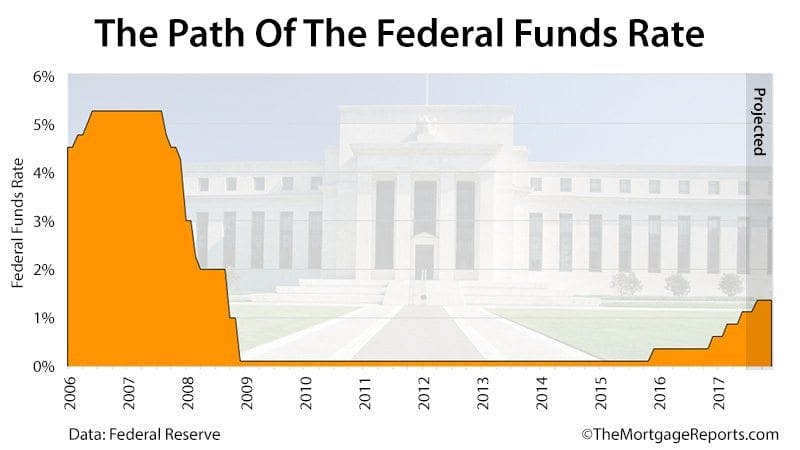
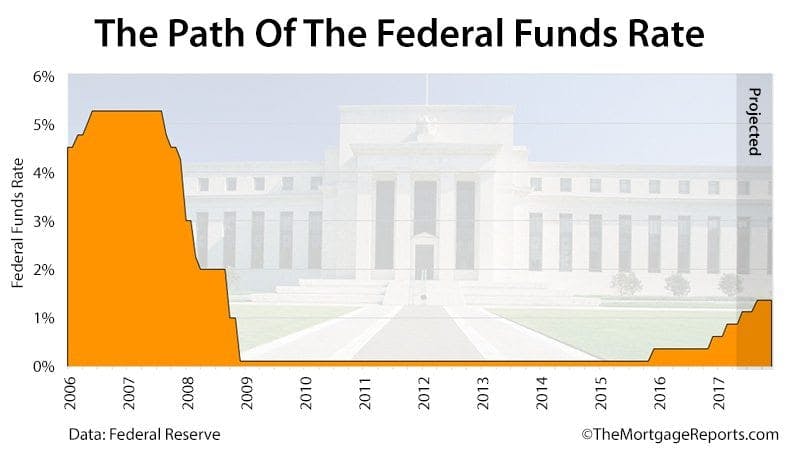
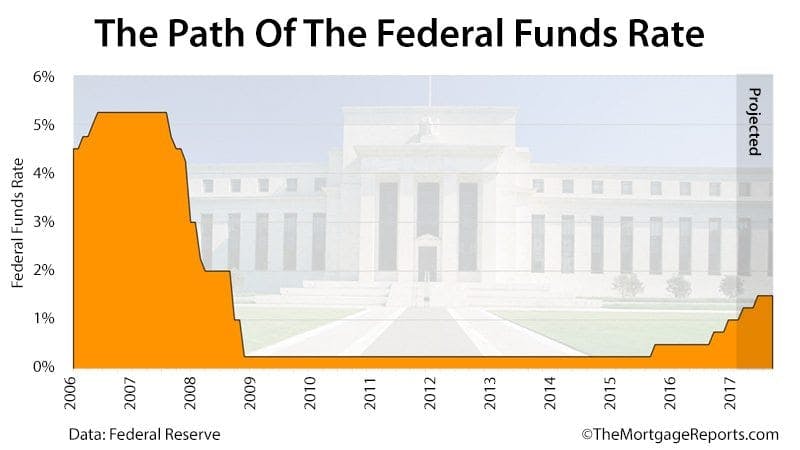
The Federal Funds Rate since April 2007Mortgage rates are notoriously volatile when the Federal Open Market Committee meets and today is such a day.  Today's meeting is one of  this year.

The Federal Open Market Committee is a rotating, 12-member sub-group within the Federal Reserve that debates about financial and economic conditions around the county, and votes on new policies meant to spur, steady, or slow economic growth.

The FOMC's economic toolbox is big, filled with programs and policies that most laypersons have never heard of, or even thought of.  The group's most well-known tool, though, also happens to be its most wielded -- the Federal Funds Rate.

The Fed Funds Rate is the rate at which banks borrow from each other overnight.  The lower the rate, the less banks pay in interest costs, and the more money is available for lending. 

It's in this way that the Fed Funds Rate impacts the economy.  When it's down, banks tend to lend more money, giving the economy room to grow.  And, conversely, when it's up, banks tend to lend less, constricting economic expansion.  This is one reason why FOMC meetings are such big news -- the Federal Reserve has a direct impact on the future of the U.S. economy.

The FOMC is expected with 100% certainty to vote the Fed Funds Rate unchanged from its current 0.000-0.250% target range at today's meeting.  Therefore, it won't be what the FOMC does that matters to mortgage rates. It will be what the FOMC says.

With the economy flopping between growth and recession, and with the Fed pledging to keep the Fed Funds Rate low for as long as necessary, markets will break down the FOMC press release for clues about what's in store economically for late-2009 and 2010.  As one example, if inflation is singled out as a threat, mortgage rates should rise because inflation erodes the value of mortgage bond repayments.

Given the current environment of low mortgage rates -- whether you live in Hyde Park, Cincinnati or Hyde Park, Chicago -- there's definitely more chance of mortgage rates rising this afternoon than falling.  There's only so much lower rates can go, you have to believe.

The Fed's press release hits the wires at 2:15 PM ET today.  If you're the cautious type, consider locking your rate prior to the release.


Dan Green is an active loan officer. Email or call 513-443-2020. Dan is on Twitter at @mortgagereports.

Tags: Back to the Future, Fed Funds Rate, federal reserve, MTV's Singled Out

Live Rate Quotes

Required fields are marked with *