If you want to be notified when I write something new on The Mortgage Reports, sign up for free daily email alerts or subscribe to the free RSS feed.

2010 Conforming Loan Limits : Same As 2009, 2008, 2007 and 2006

Posted on March 3, 2010
Filed under Conforming Loan Limits
Read the complete post

Conforming Loan Limits 2010

Conforming mortgages are appropriately named; they "conform" to the mortgage underwriting guidelines of Fannie Mae or Freddie Mac. Mortgages meeting these criteria are securitized on Wall Street as mortgage-backed bonds.

Since 2007, though, as mortgage performance has weakened, Fannie and Freddie's lending standards have tightened.  Today's would-be borrowers are asked to document more income, deeper reserves, and higher credit scores.  One underwriting area that hasn't tightened, however, is the maximum allowable loan size.

Conforming Loan Limits Vary By Property Type

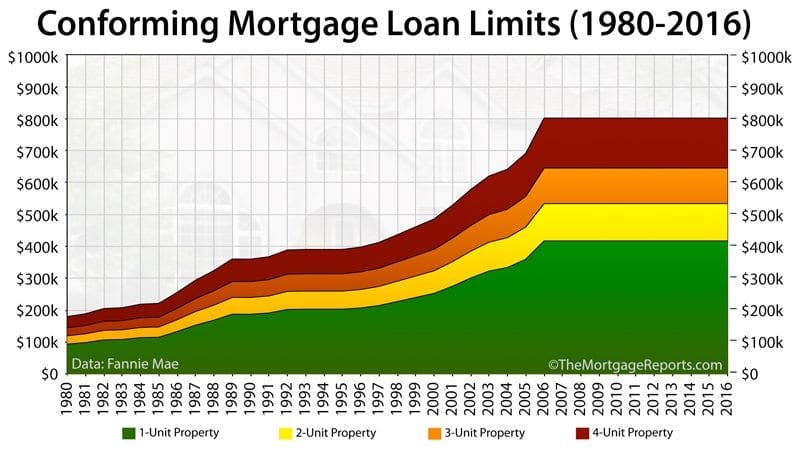
For the 5th consecutive year, the 1-unit conforming mortgage loan limit is $417,000.

As released by the Federal Housing Finance Agency, the official 2010 conforming mortgage loan size limits are, by property type:

  • 1-unit properties : $417,000
  • 2-unit properties : $533,850
  • 3-unit properties : $645,300
  • 4-unit properties : $801,950

Note, however, that maximum conforming loan limits vary by market.

Conforming Loan Limits Vary By ZIP Code

Counties in which "typical" home prices dwarf the conforming loan limits are declared "high-cost" areas. Each gets its own, individual conforming loan limit that ranges up to $729,750.

For example, a home in Denver, Colorado is capped conforming at $417,000 but a home in Snowmass, Colorado gets clearance up to $729,750. Same for Mason, Ohio as compared to Athens, Ohio.

Mason's maximum loan size is $417,000; Athens' is $432,500.

Unfortunately, there's no breaks for residents of Chicago's tony neighborhoods -- Lake Forest, Lincoln Park, Hinsdale and elsewhere. Because each of the Chicagoland counties are a melange of housing types and socioeconomic class, none have sufficiently high median sales prices to justify the High-Cost Treatment.

According to the government, neither Lake County, Cook County, Dupage County, nor the collars count as high-cost.

What To Do If Your Mortgage Is "Jumbo"

Mortgages that exceed conforming loan limits are considered "jumbo" or "super jumbo". Excellent pricing is still available, you just have to know where to look.  And it's not at Fannie Mae.

There are just 197 designated high-cost areas in the U.S. -- 6% of the country. For the majority of homeowners, therefore, the 2010 conforming loan limit is $417,000.

To find your local market's loan limit and confirm it, check the Fannie Mae website.


Dan Green is an active loan officer. Email or call 513-443-2020. Dan is on Twitter at @mortgagereports.

Tags: Conforming Loan Limits, Fannie Mae, Freddie Mac, high-cost areas

SEO Copywriting Made Simple
I use Scribe to improve my blog SEO

Why You Won’t Always Get The Lowest Advertised Mortgage Rates

Posted on January 11, 2010
Filed under Fannie Mae and Freddie Mac
Read the complete post

Loan-Level Pricing Adjustments in pictures

Mortgage rates are low but maybe not for you, specifically.

If you've ever wondered why loan officers can't give you the best "advertised rate", it's not because of a bait-and-switch scheme or something worse.  Most likely, you're being quoted higher mortgage rates because of a government mandate called Loan-Level Pricing Adjustments.

LLPAs are changes in loan costs based on your personal risk traits.

Fannie Mae and Freddie Mac first introduced loan-level pricing adjustments in April 2008 and they've been a constant cause of consternation among conforming borrowers since.

The problem is loan-level pricing adjustments aren't exactly Prime Time news and so the first time most people hear about them is at the point of application. LLPAs can raise a person's mortgage rate by a full percentage point or more.

To understand what LLPAs are and how they work, let's talk about auto insurance.

For all of us, there is some base insurance rate for which we all qualify.  It's based on our age, our credit and the ZIP code in which we park the car.  From there, however, adjustments are made -- drive a riskier car, pay a higher premium.  Have a history of accidents, pay a higher premium. Things like that.

The same goes for mortgage loans. The more the risk, the higher the rate.

A few of the risk factors that can change a person's mortgage rate include:

  • Living in a condo with less than 25% equity in the home
  • Having a credit score of less than 740
  • Living in a 2-unit, 3-unit or 4-unit home
  • Using a home as an investment property
  • Doing a "cash out" refinance with less than 40% equity in the home
  • Having a second mortgage to subordinate

Each of these traits -- historically -- increases the likelihood of your default.    Therefore, to hedge, Fannie Mae and Freddie Mac charge flat fees to offset potential future losses.

LLPAs are not discretionary fees; sources of profit or padding.  Nor are they junk fees.  LLPAs are mandatory costs triggered by specific loan characteristics.  There's no flexibility, either.  If you trigger the guidelines, you pay the fees.

The Fannie Mae Loan-Level Pricing Adjustment chart is as thorough as it is punitive. At least borrowers get to choose how they pay them:

  1. LLPAs can be paid as a traditional "closing cost", due at closing.
  2. LLPAs can be built into an interest rate. In general, interest rates increase 0.250% for each 1 percent of loan-level pricing adjustment.

It doesn't take much to trigger the risk-based pricing of Fannie Mae and Freddie Mac; a lot of conforming mortgage applicants do it.

If you've triggered the LLPA chart and want to know your options, call or . Depending on your loan traits, there may be non-government programs that can give the same great rates as Fannie and Freddie, but without the risk fees.

Be sure to ask me about it.  I answer all my own emails and would be happy to help you however I can.


Dan Green is an active loan officer. Email or call 513-443-2020. Dan is on Twitter at @mortgagereports.

Tags: Fannie Mae, Freddie Mac, LLPA, Ross Sisters, Swingers

Fannie Mae Toughens Guidelines On 2-Unit Homes, Trailing Spouses And Retirement Portfolios

Posted on July 20, 2009
Filed under Fannie Mae and Freddie Mac
Read the complete post

Fannie Mae guideline changesMortgage approvals are getting more difficult.  Again.

After reviewing recent unemployment data and market fluctuations, plus patterns of mortgage fraud, Fannie Mae is making major mortgage guideline changes for the first time in more than 6 months.

The changes are broad, impacting 15 separate areas of the mortgage approval process as detailed in Fannie Mae's official announcement.

Across-the-Board Guideline Changes:

  • Credit, income and asset documentation can't be more than 90 days old. The former guidelines allowed for 120 days.
  • Lenders must compare actual federal tax returns from the IRS to a borrower's supplied income documentation. Previously, this review step was at the lender's discretion.
  • "Tip" income must be verified.
  • Trailing secondary wage earning is now prohibited. This means that P&G employees relocating to Cincinnati can't use a spouse's "expected" Cincinnati income until that spouse actually has a job.
  • Stocks, bonds and mutual funds get assigned 70% of current market value. Formerly, this was 100%.
  • Retirement assets get assigned 60% of current market value. Formerly, this was 70%.

By themselves, these bullet points would kick more than a handful of home loans out of the underwriting queue but of all the changes Fannie Mae is making, the most impactful one may new its new restrictions on mortgages for 2-unit properties.

Until now, Fannie Mae had treated duplex homes as somewhat "safe", granting them the same liberal underwriting policies as for a single-family home.  Because of defaults and fraud prevention efforts, though, Fannie Mae decided to make getting approved for a 2-unit property decidedly more difficult.

Minimum credit scores are higher and maximum loan-to-values are lower.

When your 2-unit is your Primary Residence:

  • Purchase: Maximum LTV lowered to 80%; 640 minimum FICO.
  • Rate-and-Term Refinance: Maximum LTV lowered to 80%; 640 minimum FICO.
  • Cash Out Refinance: Maximum LTV lowered to 75%; 680 minimum FICO.

When your 2-Unit is an Investment Property

  • Purchase: Maximum LTV lowered to 75%; 660 minimum FICO.
  • Rate-and-Term Refinance: Maximum LTV lowered to 75%; 660 minimum FICO.
  • Cash Out Refinance: Maximum LTV lowered to 70%; 680 minimum FICO.

Overall, Fannie Mae's new 2-unit guidelines restrict loan-to-value limits by as much as 15 percent and raise minimum FICOs by up to 40 points -- 2 major shifts in policy.  Because of it, going forward, fewer 2-unit mortgage applicants will qualify for mortgages and that should slow both purchase and refinance activity in the 2-unit market until the market returns to balance.

It's especially tough for owners of more than 4 financed properties.

Fannie Mae has said September 1, 2009, is the "effective date" for its underwriting changes so not every lender is underwriting to the new rules just yet.  It's expected that by August 1, all of them well.

Therefore, if you know that you have a 2-unit home to refinance, or that you need your stock and/or retirement portfolio to qualify for your mortgage, consider moving up your timeframe to the next two weeks.   Lenders often implement new guidelines without advance warning and that could leave you in the cold.

Better to get a good rate today than to be ineligible for a great rate tomorrow.  If I can help you plan for an upcoming mortgage, call or email anytime.

For homeowners with owner-occupied 2-flats (i.e. live in one unit, rent the other), the new guidelines by transaction type are:

Dan Green is an active loan officer. Email or call 513-443-2020. Dan is on Twitter at @mortgagereports.

Tags: 2-units, Fannie Mae, Mortgage Guidelines

Live Rate Quotes

Required fields are marked with *