If you want to be notified when I write something new on The Mortgage Reports, sign up for free daily email alerts or subscribe to the free RSS feed.

2010 Conforming Loan Limits : Same As 2009, 2008, 2007 and 2006

Posted on March 3, 2010
Filed under Conforming Loan Limits
Read the complete post

Thanks for visiting The Mortgage Reports. To stay absolutely current on mortgage markets and important guideline changes, be sure to take my free daily email alerts.

Conforming Loan Limits 2010

Conforming mortgages are appropriately named; they "conform" to the mortgage underwriting guidelines of Fannie Mae or Freddie Mac. Mortgages meeting these criteria are securitized on Wall Street as mortgage-backed bonds.

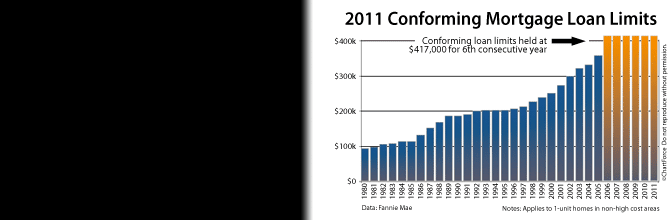
Since 2007, though, as mortgage performance has weakened, Fannie and Freddie's lending standards have tightened.  Today's would-be borrowers are asked to document more income, deeper reserves, and higher credit scores.  One underwriting area that hasn't tightened, however, is the maximum allowable loan size.

Conforming Loan Limits Vary By Property Type

For the 5th consecutive year, the 1-unit conforming mortgage loan limit is $417,000.

As released by the Federal Housing Finance Agency, the official 2010 conforming mortgage loan size limits are, by property type:

  • 1-unit properties : $417,000
  • 2-unit properties : $533,850
  • 3-unit properties : $645,300
  • 4-unit properties : $801,950

Note, however, that maximum conforming loan limits vary by market.

Conforming Loan Limits Vary By ZIP Code

Counties in which "typical" home prices dwarf the conforming loan limits are declared "high-cost" areas. Each gets its own, individual conforming loan limit that ranges up to $729,750.

For example, a home in Denver, Colorado is capped conforming at $417,000 but a home in Snowmass, Colorado gets clearance up to $729,750. Same for Mason, Ohio as compared to Athens, Ohio.

Mason's maximum loan size is $417,000; Athens' is $432,500.

Unfortunately, there's no breaks for residents of Chicago's tony neighborhoods -- Lake Forest, Lincoln Park, Hinsdale and elsewhere. Because each of the Chicagoland counties are a melange of housing types and socioeconomic class, none have sufficiently high median sales prices to justify the High-Cost Treatment.

According to the government, neither Lake County, Cook County, Dupage County, nor the collars count as high-cost.

What To Do If Your Mortgage Is "Jumbo"

Mortgages that exceed conforming loan limits are considered "jumbo" or "super jumbo". Excellent pricing is still available, you just have to know where to look.  And it's not at Fannie Mae.

There are just 197 designated high-cost areas in the U.S. -- 6% of the country. For the majority of homeowners, therefore, the 2010 conforming loan limit is $417,000.

To find your local market's loan limit and confirm it, check the Fannie Mae website.


Dan Green is an active loan officer. Email or call 513-443-2020. Dan is on Twitter at @mortgagereports.

Tags: Conforming Loan Limits, Fannie Mae, Freddie Mac, high-cost areas

SEO Copywriting Made Simple
I use Scribe to improve my blog SEO

Finding The Best Jumbo And Super Jumbo Mortgage Rates Takes Effort

Posted on November 20, 2009
Filed under Jumbo Mortgages
Read the complete post

Jumbo Mortgages and Super Jumbo Mortgages are best found on Main Street, not Wall StreetAs part of the 2009 stimulus package, Congress increased the conforming mortgage loan limit from $417,000 to as high as $729,750 in high-cost part around the county.

The recently-confirmed 2010 conforming loan limits extend the stimulus.

To be classified as "high-cost", an area's median home price must exceed $365,000.  324 areas qualify nationwide and, in each of those locales, the conforming loan limit was modified to 115% of the respective region's median home price.

Neither Chicago nor Cincinnati made the list, however.  This is because lower-cost homes co-exist with higher-cost ones, acting as a median price anchor across the region.

As a result, areas are relegated to the 2010 $417,000 conforming loan limit despite the "average" home selling for much more than that.  Areas like:

  • Lake County, Illinois
  • Indian Hill, Cincinnati, Ohio
  • Lincoln Park, Chicago, Illinois
  • Hyde Park, Cincinnati, Ohio
  • Streeterville, Chicago, Illinois

For these town residents, a $417,000 mortgage doesn't get the job done.  Homes routinely sell for $1 million or more and few homeowners want to make the downpayment to make up the difference.  Fannie Mae's loan limits are too small, in other words, so homeowners are forced to find other options.

With respect to those "other options", the pricing can get ugly.

Loans too large for Fannie Mae and Freddie Mac are commonly called "jumbo mortgages" or "super-jumbo mortgages", depending on their size.  From 2002-2007, jumbo mortgages were easy to get because investment banks, hedge funds and other financial firms were competing to invest in them.  This held rates low and guidelines loose.  Qualifying for a jumbo mortgage was easy.

Today, however, the story's a bit different.

If you've been shopping for jumbo mortgages at your bank, you already know -- jumbo mortgages are downright expensive.  Rates are high, fees are high, and banks are non-apologetic their product mix.

There is another way to get it done, though.

See, the terms "jumbo" and "super jumbo" -- these are words for a Conforming Mortgage World, as if Fannie Mae and Freddie Mac were the only games in town.  They're not.  On the contrary, if you can find your way off the beaten mortgage path, you'll discover a whole world of lenders who can help.

These little-known banks are "niche lenders", the banks of Main Street, America.  Different from Too-Big-To-Fail Banks, the smaller ones like to keep the loans on their books.  Without an "end investor", per se, Main Street banks have the freedom to underwrite as they see fit.

To a Main Street bank, $417,000 is just another number.

Main Street mortgage lenders do things that Fannie Mae or lenders making FHA home loans wouldn't touch:

  • PMI not required above 80% loan-to-value
  • Cash due at closing can be a 100% gift
  • Closing within a LLC or other entity is permitted

Furthermore, the rates are amazing.

As an example, I'm currently quoting a $1,500,000, 7-year ARM at 4.125 percent (APR 4.192).  The 5-year ARM was 3.875 (APR 4.011).  Meanwhile, I tried to shop the same scenario with a Big Bank in Cincinnati for comparison's sake.  The bank wouldn't even consider the loan for me, let alone price it.

There are other examples, too.  Niche lenders do things like:

  • $900,000 cash out mortgage with 10 percent equity, primary residence
  • $2.0 million mortgage at 60 percent LTV, primary residence
  • $3.0 million mortgage at 50 percent LTV, vacation home

Finding a Main Street-type lender isn't always easy, but it's worth the extra effort. Mortgage rates tend to be lower, downpayment requirements tend to be smaller, and the underwriting process is usually smoother. As a loan officer, I work with a lot banks like this.

If you're having trouble finding a bank to service your "large loan" or just want a second opinion, with your scenario and I'll point you in the right direction.  If I can't help you directly, I may know somebody who can.


Dan Green is an active loan officer. Email or call 513-443-2020. Dan is on Twitter at @mortgagereports.

Tags: Conforming Loan Limits, Jumbo, Super Jumbo

Where To Find The Best Pricing For Jumbo And Super-Jumbo Mortgages

Posted on February 23, 2009
Filed under Conforming Mortgage Guidelines
Read the complete post

Jumbo mortgage and super jumbo mortgage money is on Main Street. Confomring mortgage money is on Wall Street.Among the most overlooked elements of the recently-passed stimulus package is the reinstatement of 2008's conforming loan limits. 

Up from $625,500 to $729,750, homeowners in high-cost areas have a better chance of accessing today's low mortgage rates and that is good for both housing and the economy.

Areas designated as high-cost, though, are categorized as such for a reason.

Despite the hundred-thousand-dollar increase to conforming loan limits, there are still plenty of American homeowners in high-cost areas whose home loans remain too big for Fannie Mae to insure. Traditionally, we've called these out-sized loans "jumbo mortgages", or "super-jumbo mortgages".

Over the past few years, jumbo mortgages were bought and securitized by investment banks, hedge funds and other financial firms.  This helped keep rates low. 

Today, however, and as anybody shopping for a jumbo loan can attest, the dearth of both private and public investors has made getting an out-sized loan an extremely expensive proposition.  Rates on jumbo mortgages have been downright awful compared to its conforming-mortgage cousin.  Not to mention significantly higher loan fees.

Thankfully, there is a choice -- it's just not one you may have thought of.

See, the terms "jumbo" and "super jumbo" -- these are words used to describe Wall Street-bound loans and if we look beyond Wall Street, we find local banks that are happy to lend to people in need of money.

And different from Big Banks, local banks tend to keep their loans on the books, giving them permission to draw their own mortgage playbook, separate from what a Fannie Mae-bound loan requires.  We call these mortgages "portfolio loans" and if you've never seen one, the guidelines can look a little weird.

  • PMI typically not required above 80% loan-to-value
  • 100% of funds needed at closing can be gifted from anywhere
  • Closing within a LLC or other corporation is permitted

The good news for jumbo mortgage holders, though, is that portfolio lenders are killing what the likes of the Big Banks have to offer. 

For example, I'm currently quoting a $1,500,000, 7-year ARM at 5.125 percent (APR 5.221).  I tried to shop the same product at a few Big Banks -- none would even consider the loan, let alone try to price it.  And, there are plenty of other examples like this, too. 

  • $1.5 cash out mortgage with 60 percent equity, primary residence
  • $2.0 million mortgage at 65 percent LTV, primary residence
  • $3.0 million mortgage at 50 percent LTV, vacation home

On rare occasions are loans like this approvable through the largest of lenders. It often takes a niche lender to get it done. 

Jumbo and super jumbo mortgage approvals are easier with local banks and lenders as opposed to national onesFinding niche lenders isn't always easy, but it can be worth the extra effort.  Mortgage rates are often lower, downpayment requirements are often smaller, and the underwriting process is often smoother.  As a mortgage broker, I work with a lot of them.

If you're having trouble finding a bank to service your "large loan", .  I lend in all 50 states and am sure I can help you find one.


Dan Green is an active loan officer. Email or call 513-443-2020. Dan is on Twitter at @mortgagereports.

Tags: Caddyshack II, Conforming Loan Limits, Jumbo Mortgage, Super-Jumbo Mortgage, YTMND

Back To $729,750: Conforming Loan Limits In High-Cost Areas Get Stimulus Package Boost

Posted on February 20, 2009
Filed under Conforming Mortgage Guidelines
Read the complete post


Conforming Loan Limits for 2009, extended by the 2009 American Recovery and Reinvestment Act

Another day, another demand-side stimulus for the housing market.  Huzzah. 

In the sprawling 407-page stimulus bill, nestled in on page 111, Congress authorized a reinstatement of 2008's temporary conforming loan limits.  Effective immediately, home loans in high-cost areas can be insured by Fannie Mae or Freddie Mac up to $729,750.

"High-cost" means exactly what it sounds like.  A high-cost area is one in which homes are relatively expensive versus the rest of the country.  Cities like Arlington, Aspen and Maui come to mind.  Los Angeles and New York, too.

For homeowners in these areas, the standard conforming loan limit of $417,000 doesn't apply.

The definition of "high-cost" doesn't end there, though.  Different from the 2008 implementation in which sale prices across a county were used to identify high cost areas, the 2009 edition gives discretion for "sub-areas".  This is a hugely important piece of the bill -- especially for people in Chicago.

See, the Chicago Metropolitan Statistical Area includes the triangle of Chicago-Naperville-Joliet.  For all of the high-cost homes in Lincoln Park and Lakeview that would pull up the median sales prices of the region, there are low cost homes on the south and west parts of the city to pull it down, rendering all Chicagoland homeowners ineligible for the jumbo-conforming loan limits.

The same goes for Lake County, Illinois.  Because expensive North Shore homes are outnumbered out by inexpensive homes in the rest of the area, towns like Lake Forest and Northbrook were left out from the 2008 plan.

But now, because the government can legally separate Chicago into sub-areas that defy regional trends, thousands of homeowners can be suddenly eligible for low-rate conforming home loans.  This is a big deal because as mortgage rates have fallen, home buyers in Highland Park, Kenilworth, and Gold Coast have been forced into the more expensive world of Jumbo Mortgages. 

In Cincinnati, the same could be said of Indian Hill.

Now that sub-areas are eligible for high-cost treatment, we can expect demand for new homes to rise because -- in relative terms, at least -- home financing will be Sofa King cheap.

The loan limit reinstatement to $729,750 is another positive development for the housing market.  So much of its ills have been tied to falling home prices and this is just one more way for the government to spur demand.  Combine this action with the $8,000 first-time home buyer credit, Fannie Mae's re-uppance to 10 properties per person, and the ongoing foreclosure moratorium and you can practically predict how the Supply and Demand curve is going to shift.

The government hasn't yet defined which sub-areas are high-cost and which are not. To get notice of the list when it's published, and I'll forward it to you when I get it.  You can also follow me on Twitter because I'll be sure to post a link from there, too.


Dan Green is an active loan officer. Email or call 513-443-2020. Dan is on Twitter at @mortgagereports.

Tags: American Recovery and Reinvestment Act, Conforming Loan Limits, Sofa King, super-conforming

Live Rate Quotes

Required fields are marked with *