If you want to be notified when I write something new on The Mortgage Reports, sign up for free daily email alerts or subscribe to the free RSS feed.

How To Calculate Your Mortgage Payment Using Spreadsheet Formulas In Excel, Numbers, and Google Docs

Posted on September 8, 2009
Filed under Mortgage Math
Read the complete post

Thanks for visiting The Mortgage Reports. To stay absolutely current on mortgage markets and important guideline changes, be sure to take my free daily email alerts.

What will my mortgage payments be?"Can you run payments for me?"

It's among the most common questions I hear as a loan officer.  A buyer does a search for homes in Cincinnati -- maybe Blue Ash, Mason, or Symmes Township or somewhere -- and then wants to know what the monthly mortgage payments of a given house will be.

It's a question I really like to answer, actually, because "mortgage calculator" has 158 millions entries on Google. There's lot of places to get the information, and my clients choose to call me.  I like that.   It's what I'm here for, after all -- to make things as simple as possible.

Working numbers is just one way I do it.

Then, when the math is done, I like to send along 4 basic mortgage formulas for use in Microsoft Excel,  Numbers for Macintosh, or Google Docs.  The formulas come in handy when I'm not immediately available to run payments.

  1. How to calculate the monthly mortgage payment on a Principal + Interest loan
  2. How to calculate the monthly mortgage payment on an Interest Only loan
  3. How to calculate the principal paid to the mortgage in a given month
  4. How to calculate the principal paid to the mortgage in a given year

The four screenshots below show these formulas in action. The part that begins with Excelfx is what goes into the  formula bar. You are welcome to copy these for your own use.


How To Calculate Principal + Interest Payments

Excel spreadsheet formula to calculate a monthly mortgage paymentA principal + interest mortgage is the most common type of home loan.  Some people refer to it as a "regular" mortgage which implies that anything else is an "irregular" mortgage.

That implication is false.

A more accurate description of a principal + interest mortgage would be to call it a "bank-amortizing home loan" because the bank sets the payment schedule.

Most conforming and FHA mortgages use the principal + interest formula.  This includes, but is not limited to, the 30-year fixed mortgage, the 15-year fixed rate mortgage, the fixed rate Home Equity Loan and nearly all adjustable rate mortgages.


How To Calculate Interest Only Payments

Excel spreadsheet formula to calculate a monthly mortgage payment on an interest only home loanInterest only home loans are the "other" mortgage repayment choice.  They're a lot less common than they used to be, offered now, almost exclusively, via portfolio lenders.

With interest only loans, the bank doesn't tell the homeowner how much principal to pay each month. Instead, homeowners pay as much (or as little) principal as they want until the loan comes due. Versus fixed-rate loans, interest only loans are best characterized as "self-amortizing".

Interest only home loans can be a terrific financial planning when managed properly.


How To Calculate Monthly Principal Paid In A Given Month

Excel spreadsheet formula to calculate the total principal paid in a given month of a mortgageThe principal portion of a principal + interest mortgage payment increases as the mortgage moves towards maturity.

In the beginning years, the payment is mostly interest.  It's why -- after 5 years -- it can feel like you've hardly dented your mortgage balance.

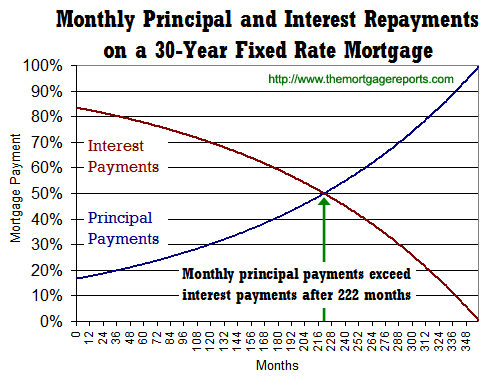
It's the nasty residue of a bank-amortizing loan. Not until sometime in Year 18 does the principal in an amortizing loan payment outweigh the interest.


How To Calculate Monthly Principal Paid In A Given Year

Excel spreadsheet formula to calculate the total principal paid in a given year of a mortgageIf you're planning to stay in your home for x years and want to know how much principal you'll have paid over that time, this formula comes in handy.

Note: This formula cannot be used to find home equity levels at some point in the future. This is because home equity is based on your home's value and not its mortgaged amount.


There are hundreds more mortgage formulas similar to the ones above. If you have specific questions about your mortgage, its payments, and the math behind it, call or .


Dan Green is an active loan officer. Email or call 513-443-2020. Dan is on Twitter at @mortgagereports.

Tags: amortization, Math, Mortgage Payments

SEO Copywriting Made Simple
I use Scribe to improve my blog SEO

It Takes 18.5 Years To Pay More Principal Than Interest With An Amortizing Mortgage

Posted on April 14, 2008
Filed under Amortization Schedules
Read the complete post

Amortization schedule for a 30-year fixed rate mortgage, principal and interest repayments

During the first few years with an amortizing home loan (i.e. principal + interest), homeowners often feel like their entire monthly payment is going towards interest.

Well, not all of it goes towards interest, the graph tells us.  Just most of it.

If you're in the early years of mortgage, though, and want to accelerate your "break-even" date to before Year 18, there are several ways to do it:

  1. Make a one-time, extra principal payment to your mortgage lender.
  2. Make monthly principal "pre-payments" to your mortgage lender.
  3. Remortgage into a lower rate mortgage, paying points if necessary.  Pay your monthly "savings" back to your mortgage lender monthly as a principal "pre-payment".

Each of these options has its own specific math so ask your loan officer for help as it relates to your personal amortization schedule.

However, it's important to understand that each of these options constitutes its own "mortgage plan" and may not be appropriate for your individual situation.  Accelerating principal payback can create huge financial rewards, but it also carries pretty big risks, too.

For example, once you've given those extra dollars to the bank, getting them back can be a real challenge.

The bank doesn't just hand over your the money because you've been a model citizen, after all. You have to apply for a new, cash-out home loan just like everybody else.  And -- in case you haven't noticed -- banks haven't been too keen on cash-out remortgages these days.

Before mailing extra principal to your mortgage company, make sure that principal repayment fits your long- and short-term financial goalsSo, there would be two possible outcomes:

  1. The bank approved your request for a cash-out remortgage and you pay bank fees to get access to your own money
  2. The bank declines your request for cash-out remortgage and you can't get access to your money at all

Either outcome can be costly so that's why you should be sure that a principal repayment strategy is in line with your overall long- and short-term financial goals before sending even $1 more to your lender.

Or, as an alternative strategy, you can also try this: Make extra principal repayments to yourself.

Each month, take the dollars that you were going to send to your lender and put them in a high-yielding savings account instead.  Make sure the account is FDIC-insured and then let the interest in that account compound over time.

By keeping the money liquid (but earmarked for your mortgage), you can have cash on hand for an emergency and pay it towards your principal later -- if it still makes sense for your plan.


Dan Green is an active loan officer. Email or call 513-443-2020. Dan is on Twitter at @mortgagereports.

Tags: amortization

Live Rate Quotes

Required fields are marked with *