Mortgage rate forecast for next week (Jun 1 - 5)
Mortgage rates rose.
The average 30-year fixed rate mortgage (FRM) increased to 6.53% on May 28, 2026 from 6.51% the prior week, according to Freddie Mac.
The 30-year fixed-rate mortgage averaged 6.53% this week. Pending home sales have increased three months in a row, indicating there’s latent demand and homebuyers are ready to jump back into the market if mortgage rates decline.
| Average 30-year fixed rate | 1-week ago | 4-weeks ago | 3-months ago | 1-year ago |
| 6.53% | 6.51% | 6.30% | 5.98% | 6.86% |
The latest borrowing activity
Though lagging, the most recent weekly mortgage application report from the Mortgage Bankers Association showed a seasonally adjusted 0.8% decrease for the seven days ending March 27. The refinance index fell 3% week-over-week while standing 4% lower from a year ago. The purchase index rose 1% weekly but came down 7% year-over-year.
“Outside of Fed policy, the U.S.-Iran War will remain in focus. The longer the conflict takes to resolve, the longer the expectation of higher inflation will remain. Higher energy prices resulting from a closed Strait of Hormuz will keep US inflation higher than hoped. Higher inflation generally means higher mortgage rates.” says Charles Goodwin, VP and Head of Bridge and DSCR Lending at Kiavi
Find your lowest mortgage rate. Start here🎧 Listen to this article (18 min)
In this article (Skip to...)
- Will rates go down in June?
- 90-day forecast
- Expert rate predictions
- Mortgage rate trends
- Rates by loan type
- Mortgage strategies for June
- Mortgage rates FAQ
Will mortgage rates go down in June 2026?
"Although the Fed doesn't control mortgage rates, cuts to the Federal Funds Rate are unlikely in the coming months. With a relatively resilient labor market, the Fed will likely want to see inflation under control before making any further cuts.“
- Dave Meyer, Chief Investment Officer at BiggerPockets
Want to see our expert mortgage insights first?
Add The Mortgage Reports as a preferred source on Google. You’ll automatically see our latest rate analyses, buying guides, and housing forecasts highlighted in your Google Search, AI Mode, and AI Overviews.
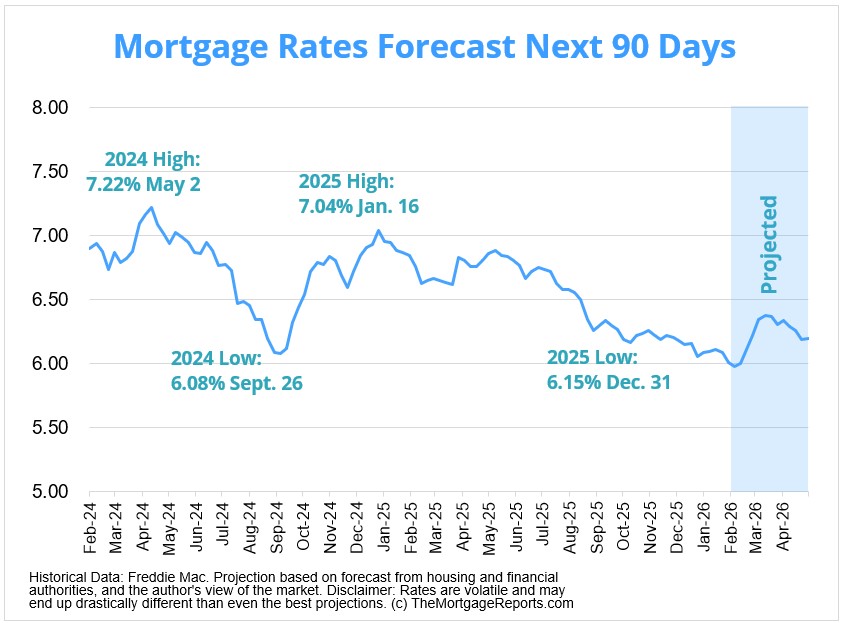
Mortgage rates fluctuated significantly in 2023, with the average 30-year fixed rate going as low as 6.09% and as high as 7.79%, according to Freddie Mac. That range narrowed from 6.08% to 7.22% in 2024, and further in 2025 between 6.15% and 7.04%. Thus far in 2026, the average 30-year moved between 5.98% and 6.46%.
We may have already seen the peak of this rate cycle. But if inflation rises, mortgage rates could uptrend. Many factors drive interest rates, which makes them subject to volatility and could change direction any given week.
Experts weighed in on whether 30-year mortgage rates will climb, fall, or level off in June.
Expert mortgage rate predictions for June

Dave Meyer, Chief Investment Officer at BiggerPockets
Prediction: Rates will hold steady
Mortgage rates are likely to remain relatively unchanged in June, averaging close to 6.5% for a 30 year fixed rate mortgage. Accelerating inflation, driven by the war in Iran, has elevated bond yields and pushed up mortgage rates. Until inflation slows down or falls, bond yields and mortgage rates are unlikely to come down. Although the Fed doesn’t control mortgage rates, cuts to the Federal Funds Rate are unlikely in the coming months. With a relatively resilient labor market, the Fed will likely want to see inflation under control before making any further cuts.

Charles Goodwin, VP and Head of Bridge and DSCR Lending at Kiavi
Prediction: Rates will hold steady
Mortgage rates are more likely to stay flat or drift upward rather than fall in June. Futures markets are currently projecting the Fed will leave the overnight borrowing rate unchanged in the mid-June meeting. Outside of Fed policy, the U.S.-Iran War will remain in focus. The longer the conflict takes to resolve, the longer the expectation of higher inflation will remain. Higher energy prices resulting from a closed Strait of Hormuz will keep US inflation higher than hoped. Higher inflation generally means higher mortgage rates. Finally, keep an eye on the “first Friday Jobs report” coming up this Friday to get the latest check on the labor market. If the labor market shows continued signs of strength, that will effectively seal the fate of no Fed rate cut in June.

Sam Williamson, Senior Economist at First American
Prediction: Rates will hold steady
Mortgage rates are likely to hold steady in the mid-6 percent range in June as financial markets await greater clarity on energy prices and geopolitical risks. Still, there are some encouraging signs that rates may start moving in the right direction. The yield on the benchmark 10-year Treasury note, which mortgage rates loosely follow, has fallen back from its mid-May highs as signs of progress toward de-escalation have emerged. Any reversal in oil markets or renewed geopolitical risk—or a more hawkish read from the June FOMC meeting and updated projections—could quickly put upward pressure back on rates. Any potential rate relief could be a key swing factor in whether improving affordability translates into stronger buyer activity this year. Cooler home price growth and rising incomes have improved affordability compared with a year ago, but the spring rebound in rates dialed back some of that momentum. A meaningful step down in rates could reopen the market to buyers who paused during the recent run-up. Until then, higher borrowing costs could limit how quickly conditions improve.

Ralph DiBugnara, President at Home Qualified
Prediction: Rates will hold steady
I expect mortgage rates in June to remain relatively in the same range as May, with the chance of slightly lower rates if Inflation Data or Labor Markets give us a little relief. Inflation being as high as it is now has been a major deterrent to any rate reductions and some may even say we need a raise in rates to combat it. My overall outlook is that rates will likely hold steady to slightly improve, but I don’t see a dramatic drop happening in the immediate future. One thing we’re continuing to see is that buyers are adapting to the current rate environment, rather than waiting on the sidelines and are out buying in large numbers again based on seasonal averages. Purchase activity has picked up across many markets this spring, especially in areas where inventory remains tight. Even with affordability challenges, there’s still strong demand from buyers who have accepted that today’s rates may simply be the new normal for now. I see the 30 year Fixed average mortgage rate holding around 6.5% for June and 15 Year fixed at 6.125%.
Mortgage interest rates forecast next 90 days
As inflation ran rampant in 2022, the Federal Reserve took action to bring it down and that led to the average 30-year fixed-rate mortgage spiking in 2023.
When inflation gradually cooled in 2024, the Fed made three rate cuts (September, November, and December). Amid the uncertainty and chaos of 2025, the Federal Reserve Open Market Committee held the federal funds rate range steady at its first five meetings, before continued instability and weakened job markets justified three cuts to end the year. The central bank then held rates at its first 2026 meeting, resuming its wait-and-see approach during a time of murky economic outlooks.
Find your lowest mortgage rate. Start hereOf course, rates could rise or fall on any given week due to many factors or if another global event causes widespread uncertainty in the economy.
Mortgage rate predictions for June 2026
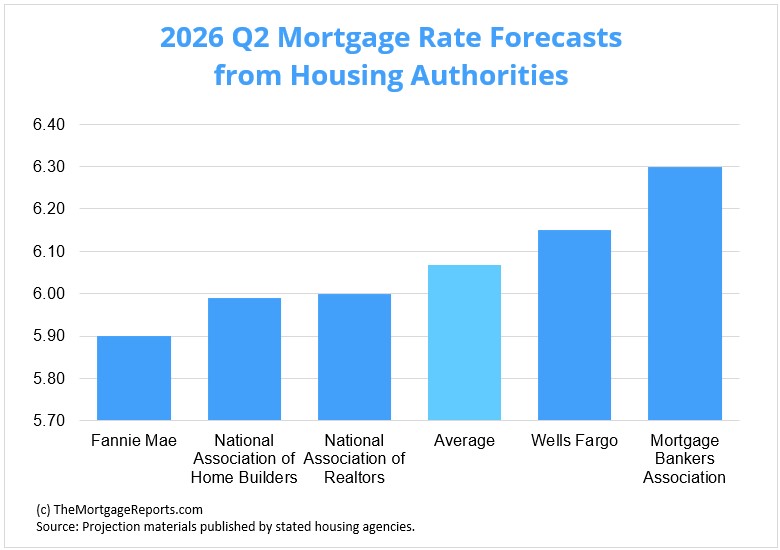
The 30-year fixed-rate mortgage averaged 6.53% as of May 28, according to Freddie Mac. All five of the major housing authorities we looked at predict 2026’s second quarter average to finish below that.
Fannie Mae sits at the low end of the group, projecting the average 30-year fixed interest rate to settle at 5.9%. Meanwhile, the Mortgage Bankers Association had the highest Q2 forecast of 6.3%.
| Housing Authority | 30-Year Mortgage Rate Forecast (Q2 2026) |
| National Association of Home Builders | 5.99% |
| National Association of Realtors | 6.00% |
| Wells Fargo | 6.15% |
| Fannie Mae | 6.30% |
| Mortgage Bankers Association | 6.30% |
| Average Prediction | 6.148% |
Current mortgage interest rate trends
As of May 28, 2026, Freddie Mac’s weekly survey shows the average 30-year fixed mortgage increased to 6.53%.
The average 30-year fixed rate increased to 6.53% on May. 28 from 6.51% on May. 21. Meanwhile, the average 15-year fixed mortgage rate rose to 5.87% from 5.85%.
| May 2026 | 6.53% |
| March 2025 | 6.65% |
| April 2025 | 6.73% |
| May 2025 | 6.82% |
| June 2025 | 6.82% |
| July 2025 | 6.72% |
| August 2025 | 6.59% |
| September 2025 | 6.35% |
| October 2025 | 6.25% |
| November 2025 | 6.24% |
| December 2025 | 6.19% |
| January 2026 | 6.10% |
| February 2026 | 6.05% |
| March 2026 | 6.18% |
Source: Freddie Mac
After hitting record-low territory in 2020 and 2021, mortgage rates climbed to a 23-year high in 2023 before descending over 2024 and 2025. Many experts and industry authorities believe they will follow a downward trajectory in 2026. Whatever happens, interest rates are still below historical averages.
Dating back to April 1971, the fixed 30-year interest rate averaged around 7.8%, according to Freddie Mac. So if you haven’t locked a rate yet, don’t lose too much sleep over it. You can still get a good deal, historically speaking — especially if you’re a borrower with strong credit.
Just make sure you shop around to find the best lender and lowest rate for your unique situation.
Mortgage rate forecast by loan type
Loan-type trends were mixed this week, with 30-year fixed at 6.53% and 15-year fixed at 5.87%.
Find your lowest mortgage rate. Start hereWhich mortgage loan is best?
The best mortgage for you depends on your financial situation and your goals.
For instance, if you want to buy a high-priced home and you have great credit, a jumbo loan is your best bet. Jumbo mortgages allow loan amounts above conforming loan limits, which max out at $832,750 in most parts of the U.S.
On the other hand, if you’re a veteran or service member, a VA loan is almost always the right choice. VA loans are backed by the U.S. Department of Veterans Affairs. They provide ultra-low rates and never charge private mortgage insurance (PMI). But you need an eligible service history to qualify.
Conforming loans and FHA loans (those backed by the Federal Housing Administration) are great low-down-payment options.
Conforming loans allow as little as 3% down with FICO scores starting at 620. FHA loans are even more lenient about credit; home buyers can often qualify with a score of 580 or higher, and a less-than-perfect credit history might not disqualify you.
Finally, consider a USDA loan if you want to buy or refinance real estate in a rural area. USDA loans have below-market rates — similar to VA — and reduced mortgage insurance costs. The catch? You need to live in a ‘rural’ area and have moderate or low income to be USDA-eligible.
Mortgage rate strategies for June 2026
Mortgage rates displayed their famous volatility throughout 2024 before 2025’s gradual downtrend. The Federal Reserve ended 2025 with three-straight rate cuts and projected the potential for more in 2026, providing optimism for modestly descending rates over the course of the year.
Find your lowest mortgage rate. Start hereHowever, the Trump Administration’s power consolidation, alongside unstable inflation caused the Fed to pause in January. Then, the war against Iran and the elevated uncertainty brought another hold in March.
As always, the committee said it would adjust its policies as necessary — which could mean additional cuts, none at all or even possible raises.
Here are just a few strategies to keep in mind if you’re mortgage shopping in the coming months.
Be ready to move quickly
Indecision can lead to failure or missed opportunities. That holds true in home buying as well.
Although the housing market is becoming more balanced than the recent past, it still favors sellers. Prospective borrowers should take the lessons learned from the last few years and apply them now even though conditions are less extreme.
“Taking too long to decide to make an offer can lead to paying more for the home at best and at worst to losing out on it entirely. Buyers should get pre-approved (not pre-qualified) for their mortgage, so that the seller has some certainty about the deal closing. And be ready to close quickly — a long escrow period will put you at a disadvantage.
“And it’s definitely not a bad idea to work with a real estate agent who has access to “coming soon” properties, which can give a buyer a little bit of a head start competing for the limited number of homes available,” said Rick Sharga.
If mortgage rates continue on a downward trajectory, more and more buyers will likely enter the market after being priced out on the sidelines. Being decisive (and prepared) should only play to your advantage.
Shopping around isn’t only for the holidays
Since interest rates can vary drastically from day to day and from lender to lender, failing to shop around likely leads to money lost.
Lenders charge different rates for different levels of credit scores. And while there are ways to negotiate a lower mortgage rate, the easiest is to get multiple quotes from multiple lenders and leverage them against each other.
“For potential home buyers, it’s important to get quotes from multiple lenders for a mortgage, as rates can vary dramatically, especially during such a volatile period,” said Odeta Kushi.
As the mortgage market slows due to lessened demand, lenders will be more eager for business. While missing out on the rock-bottom rates of 2020 and 2021 may sting, there’s always a way to use the market to your advantage.
How to shop for interest rates
Rate shopping doesn’t just mean looking at the lowest rates advertised online because those aren’t available to everyone. Typically, those are offered to borrowers with great credit who can put a down payment of 20% or more.
The rate lenders actually offer depends on:
- Your credit score and credit history
- Your personal finances
- Your down payment (if buying a home)
- Your home equity (if refinancing)
- Your loan-to-value ratio (LTV)
- Your debt-to-income ratio (DTI)
To figure out what rate a lender can offer you based on those factors, you have to fill out a loan application. Lenders will check your credit and verify your income and debts, then give you a ‘real’ rate quote based on your financial situation.
You should get three to five of these quotes at a minimum, then compare them to find the best offer. Look for the lowest rate, but also pay attention to your annual percentage rate (APR), estimated closing costs, and ‘discount points’ — extra fees charged upfront to lower your rate.
This might sound like a lot of work. But you can shop for mortgage rates in under a day if you put your mind to it. And shaving just a few basis points off your rate can save you thousands.
Compare mortgage and refinance rates. Start here
Mortgage interest rate FAQ
What are today’s mortgage rates?
Mortgage rates are rising, but borrowers can almost always find a better deal by shopping around. Connect with a mortgage lender to find out exactly what rate you qualify for.
Time to make a move? Let us find the right mortgage for you1Today's mortgage rates are based on a daily survey of select lending partners of The Mortgage Reports. Interest rates shown here assume a credit score of 740. See our full loan assumptions here.
Selected sources:
- https://www.federalreserve.gov/monetarypolicy/fomccalendars.htm
- http://www.freddiemac.com/research/datasets/refinance-stats/index.page